The idea sounds straightforward: publish a file at /llms.txt, summarize your company and content, and make it easier for ChatGPT and other AI systems to understand your website. For a technical team, it looks like a small implementation with potentially large upside. For a marketing team, it’s the missing step between content and being recommended by AI.
The current evidence doesn’t support treating llms.txt as a proven ranking or citation lever. It’s better understood as an open proposal for helping agents navigate a website. If your Webflow site has unresolved indexing, content, or performance problems, adding the file first is likely to create the appearance of progress without addressing the issues that actually limit visibility.
What llms.txt Is Supposed to Do
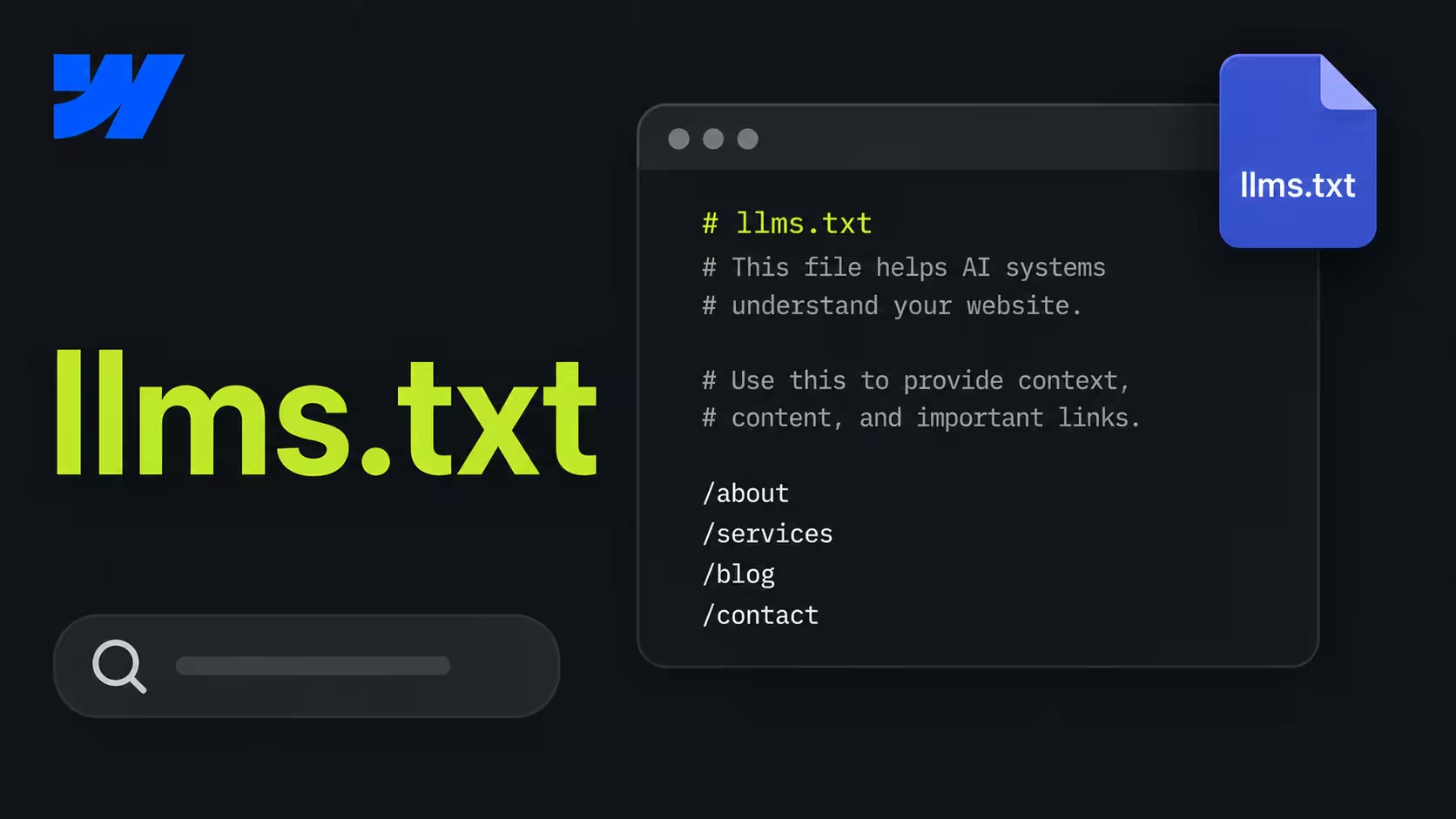
The llms.txt proposal describes a Markdown file placed at the root of a website or at a relevant subpath, such as /docs/llms.txt. Its purpose is to give agents a compact orientation to a project, including a title, a short summary, useful context, and curated links to more detailed resources.
The proposed format is intentionally simple. The only required element is an H1 containing the site or project name. A recommended file can also include a blockquote summary, short explanatory notes, and H2 sections containing Markdown links to important pages. Those links should point to useful, detailed content rather than merely reproducing a sitemap.
That distinction matters. A sitemap is designed to enumerate URLs for search-engine discovery. Robots.txt communicates crawler access preferences. Schema markup describes entities and relationships in machine-readable data. An llms.txt file is meant to provide editorial orientation: a concise guide that tells an agent which parts of a large website are worth reading and how to interpret them.
For documentation sites, this use case is easy to understand. A developer asking an AI agent how to use a library may benefit from a curated list of the quick start guide, API reference, migration notes and examples. For a marketing website, the benefit is less certain because the most important business information should already be present in crawlable pages, clear navigation, structured data, and external brand references.
What the Research Says About Citations
The most useful large-scale evidence currently available comes from SE Ranking’s analysis of approximately 300,000 domains. The study found that only 10.13% of the domains in its sample had an llms.txt file, and adoption was not concentrated only among the largest or most visible websites.
The key result was that the presence of llms.txt showed no measurable relationship with how frequently a domain was cited in answers from major language models. SE Ranking used correlation tests and an XGBoost model to evaluate whether llms.txt contributed to citation frequency. The model reportedly became more accurate when the llms.txt feature was removed, while the simpler statistical analysis also found no significant correlation.
This doesn’t prove that no AI system will ever use llms.txt. It does show that, at the scale measured, publishing the file was not associated with a reliable citation advantage. The distinction is important for teams deciding where to spend limited time: “not proven to help” is very different from “technically impossible” but both conclusions argue against making llms.txt the centerpiece of an AI-search strategy.
Another study cited in the same discussion examined 94,614 cited URLs across 11,867 responses and found only one citation originating from an llms.txt file. These results should be treated carefully because they are not identical methodologies, but together they reinforce the same practical conclusion: the file is not currently a dependable route to more citations.
What Google and OpenAI Say
Google’s public AI-search guidance doesn’t identify llms.txt as a required technical condition for appearing in AI Overviews or AI Mode. Google frames its generative search features as an extension of existing Search systems, meaning the core requirements remain crawlability, indexability, helpful content, and compliance with Google’s guidelines.
The practical conclusion is straightforward: you don’t need llms.txt to appear in Google Search or Google’s AI features. Publishing one should not be presented as a Google ranking requirement, and its presence should not be treated as evidence that a site is optimized for Google’s answer layer.
OpenAI’s official crawler documentation focuses on its user agents and robots.txt controls. OAI-SearchBot relates to search discovery, GPTBot relates to model training, and ChatGPT-User relates to user-initiated retrieval. OpenAI doesn’t publicly say that llms.txt improves ChatGPT ranking or guarantees citations. If ChatGPT visibility is the goal, allowing the relevant crawler and making the actual pages accessible remain more defensible priorities than assuming a special file will be consumed.
llms.txt Is Not robots.txt
These files are often discussed together, but they solve different problems:
- robots.txt tells crawlers which areas they may or may not access - it’s an access-control signal.
- sitemap.xml lists URLs that search engines can discover and crawl - it’s a URL inventory.
- Schema markup describes entities, relationships, and page content in a machine-readable format.
- llms.txt proposes a curated Markdown orientation file that points agents toward selected resources - it’s a navigation and context layer.
Adding llms.txt cannot repair a robots.txt rule that blocks important pages. It cannot make a page indexable if the page has a noindex directive, a broken canonical, or no meaningful content in the initial HTML. It also cannot compensate for an unclear information architecture, weak internal linking, or a website that takes too long to load.
This is where implementation priorities often go wrong. A team may spend an afternoon creating a polished llms.txt file while leaving a high-value service page orphaned, a CMS template missing metadata, or a navigation component dependent on JavaScript. The file may be technically correct, but the site remains difficult to discover and understand.
Where llms.txt Can Still Make Sense
The fact that citation uplift is unproven doesn’t make the proposal useless in every situation. It may be sensible when a website has a large, complex resource library and the file can genuinely reduce the effort required for an agent to find the right material.
The strongest use cases:
- Developer documentation with separate quick starts, API references, examples, and migration guides.
- Large knowledge bases where the most authoritative articles are difficult to distinguish from outdated or low-value pages.
- Product ecosystems with public documentation, implementation guides, integration references, and support policies.
- Organizations that want to create a concise, human-readable inventory of their most important public resources.
The value in these cases is operational and navigational, not necessarily a ranking boost. A well-written file can help your readers understand the site’s structure, provide a useful starting point for an agent that chooses to read it, and create a low-cost artifact that may become more relevant as adoption develops.
The llms.txt specification itself now recommends concise language, informative link descriptions, and testing the file by asking an agent questions while providing the file as a starting point. That’s a useful quality standard even if citation impact remains unproven.
How to Implement It on Webflow
Webflow doesn’t make an llms.txt file a substitute for the platform’s normal SEO settings. A Webflow team typically needs to create and serve the file separately from the page’s title tags, sitemap, robots.txt, and schema implementation.
There are several possible implementation paths:
- Static hosting or edge configuration: Serve /llms.txt from the site root through the hosting or CDN layer if the environment supports custom static files.
- Webflow custom code or integration workflow: Use a supported integration or external automation to generate and publish the file, especially when its links need to be updated from CMS content.
- Third-party tooling: Tools like Schema Flow and other Webflow integrations can generate machine-readable assets or bind structured content to CMS fields, although each tool should be evaluated for how it handles the specific llms.txt format.
- Manual maintenance: For a smaller site, publish a concise file and update it whenever the most important pages, services, documentation, or URLs change.
A marketing site file might look like this:
# Designbase

> Designbase is a Webflow Premium Partner agency building and optimizing Webflow websites for B2B marketing teams, so they can ship pages in hours, not weeks. Founded in 2017, based in Wörthsee, Germany, serving clients worldwide.

Designbase offers Webflow website builds and rebuilds, ongoing growth retainers, and personalized ABM landing pages powered by Clay + Webflow. The site is available in English (default) and German (/de/).

## Services

- [Design to Webflow](https://www.designbase.studio/webflow-expert-agency): Turn a Figma design into a fast, modular, CMS-driven Webflow website, with team training included.
- [Website Rebuild](https://www.designbase.studio/webflow-rebuild-agency): Rebuild a messy Webflow site on a clean component system without changing design or content.
- [Growth Retainer](https://www.designbase.studio/webflow-maintenance): Ongoing Webflow maintenance, SEO, and growth support on a monthly retainer.
- [Personalized Landing Pages](https://www.designbase.studio/personalized-landing-pages): Auto-generate personalized ABM landing pages at scale using Clay and Webflow.

## Case Studies

- [All Cases](https://www.designbase.studio/cases): Overview of Designbase's Webflow project case studies.
- [Instaffo](https://www.designbase.studio/cases/instaffo): Brand unification and a €10M funding round after a four-year partnership.
- [talque](https://www.designbase.studio/cases/talque): An 88-page, two-language Webflow rebuild for a market-leading event-tech platform.
- [Crewmeister](https://www.designbase.studio/cases/crewmeister): A CMS-driven rebuild that lifted conversion rate by 50%.
- [Weflow](https://www.designbase.studio/cases/weflow): Ongoing Webflow evolution for a growing SaaS platform since 2023.
- [Filics](https://www.designbase.studio/cases/filics): A full website rebuild delivered in 14 days ahead of a trade show deadline.
- [Bloomwell](https://www.designbase.studio/cases/bloomwell): A 123-component rebuild automating 850+ products for a cannabis telemedicine startup.
- [Paybyrd](https://www.designbase.studio/cases/paybyrd): A premium fintech-grade Webflow build with custom GSAP animation.

## Company

- [About](https://www.designbase.studio/about): How Designbase works, its principles, and its team.
- [Book a Call](https://www.designbase.studio/book-a-call): Schedule a free 30-minute call with Designbase.
- [Blog](https://www.designbase.studio/blog): Webflow tutorials, marketing insights, and product updates.

## Resources

- [ABM Blueprint](https://www.designbase.studio/abm-blueprint): Free video walkthrough, Webflow cloneable, and Clay table for scalable account-based marketing.

## Legal

- [Legal Notice](https://www.designbase.studio/legal)
- [Privacy Policy](https://www.designbase.studio/privacy-policy)
- [Terms and Conditions](https://www.designbase.studio/terms-and-conditions)

---

# Designbase (Deutsch)

> Designbase ist eine Webflow-Premium-Partner-Agentur, die Webflow-Websites für B2B-Marketingteams entwickelt und optimiert, damit sie Seiten in Stunden statt in Wochen veröffentlichen können. Gegründet 2017, ansässig in Wörthsee, weltweit tätig.

Designbase bietet Webflow-Website-Builds und -Neuaufbauten, laufende Growth Retainer und personalisierte ABM-Landing-Pages mit Clay + Webflow an. Die Seite ist auf Englisch (Standard) und Deutsch (/de/) verfügbar.

## Leistungen

- [Design to Webflow](https://www.designbase.studio/de/webflow-experte): Verwandelt ein Figma-Design in eine schnelle, modulare, CMS-gestützte Webflow-Website, inklusive Team-Schulung.
- [Website-Neuaufbau](https://www.designbase.studio/de/webflow-rebuild-agentur): Baut eine unübersichtlich gewordene Webflow-Website auf einem sauberen Komponentensystem neu, ohne Design oder Inhalte zu verändern.
- [Growth Retainer](https://www.designbase.studio/de/webflow-wartung): Laufende Webflow-Wartung, SEO und Wachstumsbetreuung im Monatspaket.
- [Personalisierte Landing Pages](https://www.designbase.studio/de/personalized-landing-pages): Generiert automatisch personalisierte ABM-Landing-Pages im großen Stil mit Clay und Webflow.

## Case Studies

- [Alle Cases](https://www.designbase.studio/de/cases): Übersicht aller Webflow-Projekt-Case-Studies von Designbase.
- [Instaffo](https://www.designbase.studio/de/cases/instaffo): Markenvereinheitlichung und eine Finanzierungsrunde über 10 Mio. Euro nach vierjähriger Partnerschaft.
- [talque](https://www.designbase.studio/de/cases/talque): Ein Webflow-Neuaufbau mit 88 Seiten in zwei Sprachen für eine marktführende Event-Tech-Plattform.
- [Crewmeister](https://www.designbase.studio/de/cases/crewmeister): Ein CMS-gestützter Neuaufbau, der die Conversion Rate um 50 Prozent steigerte.
- [Weflow](https://www.designbase.studio/de/cases/weflow): Laufende Webflow-Weiterentwicklung für eine wachsende SaaS-Plattform seit 2023.
- [Filics](https://www.designbase.studio/de/cases/filics): Ein kompletter Website-Neuaufbau, geliefert in 14 Tagen vor einer Messe-Deadline.
- [Bloomwell](https://www.designbase.studio/de/cases/bloomwell): Ein Neuaufbau mit 123 Components, der über 850 Produkte für ein Cannabis-Telemedizin-Startup automatisiert.
- [Paybyrd](https://www.designbase.studio/de/cases/paybyrd): Ein Webflow-Build auf Fintech-Niveau mit individueller GSAP-Animation.

## Unternehmen

- [Über uns](https://www.designbase.studio/de/uber-uns): Wie Designbase arbeitet, seine Prinzipien und sein Team.
- [Call buchen](https://www.designbase.studio/de/anfragen): Ein kostenloses 30-minütiges Gespräch mit Designbase vereinbaren.
- [Blog](https://www.designbase.studio/de/blog): Webflow-Tutorials, Marketing-Insights und Produkt-Updates.

## Ressourcen

- [ABM Blueprint](https://www.designbase.studio/de/abm-blueprint): Kostenloses Video, Webflow-Vorlage und Clay-Tabelle für skalierbares Account-Based Marketing.

## Rechtliches

- [Impressum](https://www.designbase.studio/de/impressum)
- [Datenschutzerklärung](https://www.designbase.studio/de/datenschutz)
- [Allgemeine Geschäftsbedingungen](https://www.designbase.studio/de/agb)
Technical Checks Before Publishing
If you decide to implement llms.txt, treat it like a small technical asset rather than a marketing page. Check the following before it goes live:
- Confirm that https://example.com/llms.txt returns a successful response and is accessible without cookies, authentication, or client-side rendering.
- Use the correct Content-Type, ideally a text-based response like text/plain or text/markdown where the hosting environment supports it.
- Use absolute HTTPS URLs for linked pages so agents don’t have to resolve relative paths.
- Link only to canonical pages that return a successful status and do not redirect unnecessarily.
- Keep the file within the intended scope: a root file describes the website broadly, while a file under /docs/ can describe documentation only.
- Remove links to pages that are blocked in robots.txt or marked noindex if the intention is to guide an agent toward usable public content.
- Check the file after every migration, URL restructuring, or major content update.
- Do not include confidential information, unpublished positioning, internal URLs, or claims that are not supported by the visible site.
These checks are simple, but they are where many “set and forget” implementations degrade. A file that was accurate at launch may contain broken links or outdated descriptions six months later.
What to Prioritize Before Uploading llms.txt
For most marketing websites, the priority order should be the reverse of the hype cycle. Start by making the pages that matter accessible and understandable, then consider adding the file as a low-cost supplement.
1. Crawlability and Indexability
Check robots.txt, XML sitemaps, canonical tags, noindex directives, status codes, redirect chains, and internal links. A search system cannot cite a page it cannot discover or index. On Webflow, review published URLs, collection template behavior, sitemap output, and custom code that may add conflicting metadata.
2. Content in the Initial HTML
If key service explanations, product details, or proof points appear only after JavaScript runs, a non-rendering crawler may not see them. Keep the central meaning of each page in accessible HTML, with clear headings and direct answers that make sense without interacting with the interface.
3. Page and Content Structure
Give each page a clear job. A service page should explain the service, audience, process, proof, and next step. A supporting article should answer a focused question and point readers toward the relevant service. Avoid making one page compete with several others for the same intent.
4. Entity and Author Clarity
Use consistent company details, author profiles, publisher information, and structured data. Connect the organization to its real external profiles where appropriate, and make sure the information in schema matches what users can see.
5. Internal Linking and Navigation
Link related articles to service pages, connect topic hubs to supporting pages, and ensure important URLs are reachable through standard HTML links. A curated llms.txt file can point an agent toward useful pages, but the website itself still needs a coherent architecture.
6. Performance and Experience
A fast, stable site gives both users and crawlers a better experience. On Webflow, audit image sizes, font loading, third party scripts, animations, embedded tools, and custom JavaScript. Don’t let a new AI-related asset distract from the performance issues affecting every visitor.
What This Means for Webflow Teams
Webflow makes it relatively straightforward to manage many of the fundamentals that matter more immediately: page titles, descriptions, canonical settings, redirects, sitemaps, structured content, and custom code. It also makes it possible to build clean CMS templates that let a marketing team update content without waiting for engineering.
That flexibility creates a responsibility. A Webflow site can be technically clean, but it can also accumulate inconsistent CMS fields, duplicated templates, heavy third party scripts, hidden content, and custom code that nobody reviews. The platform doesn’t automatically turn every implementation into a search-ready one.
If an llms.txt file is added, it should fit into the site’s existing operating model. The owner should know which pages it covers, how links will be updated, and what happens during a redesign or migration. Without that ownership, the file becomes another abandoned artifact alongside old sitemaps, stale metadata, and unused integrations.
For teams without the time or technical depth to manage that layer, our Webflow SEO services offer a more durable path: audit the existing site, fix the issues affecting discovery and performance, structure the content properly, and implement optional AI-search assets only where they make sense.
FAQs
There’s no public evidence that Google uses llms.txt as a ranking signal or requires it for AI Overviews or AI Mode. Google’s AI-search guidance continues to emphasize the same core foundations as regular Search, including crawlability, indexability, helpful content, and technical compliance.
There is no reliable evidence that simply publishing llms.txt causes ChatGPT to cite a website more often. Large-scale analysis has found no measurable relationship between the file and AI citation frequency, while OpenAI’s public crawler guidance focuses on OAI-SearchBot access and robots.txt controls.
No. Robots.txt controls crawler access, sitemap.xml lists URLs for discovery, schema markup describes entities and content, and llms.txt is a proposed Markdown guide that gives agents a curated overview of a website.
It’s optional, but still suggested. It can be reasonable for a large Webflow site with extensive documentation, resources, or a complex CMS, but it should come after crawlability, page structure, content quality, internal linking, performance, and schema have been addressed.
The biggest mistake is treating it as a replacement for technical SEO. A well-written file cannot fix blocked pages, weak content, broken links, poor site architecture, slow performance, or missing authority signals. It should point toward a strong website, not try to compensate for a weak one.