
Majority of B2B SaaS businesses treat their website as a project. Something you scope, design, build, and eventually move on from. It goes live, gets a round of internal applause, and then slowly becomes a liability - outdated messaging, pages that no longer reflect the product, a redesign that's been “in the backlog” for six months.
The teams winning in 2026 treat their website differently. They treat it as infrastructure. There’s a meaningful distinction between these two, and Webflow has become the platform sitting at the center of it. Not because it supports the most visually impressive sites but because of what it enables operationally for faster-go-to-market teams.
The Problem with “Website as Project”
The traditional approach to a company website has a structural flaw that most teams don't notice until they are deep inside a deal cycle, a campaign, or a product pivot.
The flaw is dependency. Marketing wants to test a new hero message. They mention it to design. Design queues it with engineering. Engineering has three other priorities. Three weeks later, a variant goes live that nobody is particularly confident in, the moment has passed, and the test data is inconclusive because the traffic window was wrong.
This is not a process failure. It’s an architectural one. When the website requires engineering involvement for anything beyond the most surface-level changes, it creates a bottleneck that compounds over time. Messaging drifts out of sync with what sales is saying on calls. Landing pages from Q3 campaigns stay live in Q1 because nobody has the bandwidth to update or retire them. The site that cost $150,000 to build 18 months ago is quietly undermining pipeline because it no longer reflects who you sell to, what you sell, or why it matters.
For B2B SaaS companies in particular, this is a serious problem. The ICP shifts. The product evolves. The competitive landscape changes. GTM strategy is not static, and a website that can only update on a development sprint cycle is not equipped to keep pace.
What GTM Infrastructure Actually Means
GTM infrastructure is the set of systems and surfaces that enable a revenue team to create pipeline, convert it, and move it forward at speed. It includes your CRM, your outbound tooling, your intent data layer, your attribution stack, and your content operation. These are the operating environment inside which pipeline gets created or doesn't.
The website is the convergence point of all of it.
Every paid campaign lands somewhere on the website. Every outbound sequence points a prospect toward it. Every organic piece of content lives there. Every product-led motion - whether a free trial, a demo, or a calculator - runs through it. The website is where your GTM motion touches the prospect most directly, most repeatedly, and most consequentially.
If that surface is slow to update, hard to personalize, difficult to instrument, and disconnected from the rest of your stack, you have a GTM infrastructure problem - and it’s disguised as a website problem.
This reframe matters for founders and marketing leads because it changes what decisions you make. A website that is GTM infrastructure gets resourced like infrastructure. It gets maintained. It has an owner. It is treated as a system that requires ongoing iteration, not a deliverable that gets handed off.
The difference in practice is clear as a day:
Most SaaS companies sit firmly in the left column. The ones generating consistent pipeline from their web presence have moved to the right.
Why Webflow Fits the B2B SaaS GTM Stack
Webflow is not the only platform that can serve as the foundation for a GTM-oriented website. But several things make it particularly well-suited for the way modern B2B SaaS companies operate.
Marketing Can Move Without Engineering
This is the most operationally important thing Webflow enables. Once a site is built on a solid design system within Webflow, marketing can create new pages, update copy, publish blog posts, spin up landing page variants, and iterate on conversion elements without touching code and without filing a ticket. The bottleneck that bothers most SaaS marketing teams is architecturally removed.
The CMS Is Built for Scale
Webflow's CMS is not just a blog tool. It can power programmatic page structures - solution pages, comparison pages, use-case pages, industry verticals - that give organic search a real foothold. For B2B SaaS companies trying to build organic as a meaningful GTM channel, this matters. You can build structured content programs that generate pages at scale, all within a design system that keeps everything on-brand.
It Integrates Cleanly With the Modern GTM Stack
HubSpot, Salesforce, Clay, Clearbit, intent data platforms, analytics tools, attribution layers - these are the systems that B2B revenue teams run on. Webflow connects to all of them, either natively or via lightweight integrations. The website does not sit apart from the GTM stack - it becomes the front end of it.
Performance Is a Genuine Advantage
Webflow generates clean, lean code. Core Web Vitals are consistently strong on well-built Webflow sites. For SEO - which for most B2B SaaS companies is a primary GTM channel - this is not a minor point. Page experience is a ranking factor, and load speed directly affects conversion rates on paid landing pages.
What B2B SaaS Teams Actually Build in Webflow
The shift from website as project to website as GTM infrastructure becomes concrete when you look at what revenue teams are actually shipping in Webflow.
ABM Landing Pages
Account-based marketing requires surfaces that speak to specific accounts, segments, or verticals in a way that generic pages cannot. Webflow makes it practical to build and maintain a library of personalized landing pages - by ICP tier, by industry, by named account if needed - without treating each one as a custom development project.
These pages are not one-off vanity builds. They sit inside a consistent design system, pull from shared CMS components, and connect to the same conversion infrastructure as the rest of the site. They can be built, tested, and iterated on by a marketing team operating at speed.
Intent-Based Conversion Pages
Intent data platforms surface signals about which companies are in-market for what you sell. That signal is only useful if your website can respond to it. High-intent visitors from a target account land on a page that reflects their context - their industry, their use case, their stage of research - and the experience converts better as a result.
Building and maintaining that library of intent-responsive pages requires a web platform where the marketing team controls the publishing workflow. Webflow is that platform.
Campaign Landing Pages
Paid and outbound campaigns need dedicated landing pages - pages with controlled messaging, a single conversion goal, and no navigation distractions. In most engineering-dependent web setups, these pages are either built slowly, borrowed from existing pages that do not quite fit, or left undone entirely. In Webflow, a campaign page that matches ad creative, reflects the specific offer, and routes correctly into HubSpot or Salesforce can be live in a day.
This is not a small operational win. The ability to move from campaign brief to live landing page in hours rather than weeks changes what is possible in a given quarter.
Programmatic SEO
For B2B SaaS companies with a broad ICP or a multi-use-case product, programmatic SEO is a meaningful growth lever. Webflow's CMS enables you to build structured page templates that populate across hundreds or thousands of URL variations - each one targeting a specific search query, industry, or problem - without duplicating design or development effort on each page.
The pages that convert these organic visitors then feed into the same GTM motion as every other channel. Organic stops being a content team project and starts being a pipeline source.
Partner and Co-Marketing Pages
Joint landing pages for partnerships, integrations, and co-marketing campaigns are operationally annoying in most web setups. They involve back-and-forth on design, requests to development, and pages that often go live late if they go live at all.
In Webflow, a partner page that reflects both brands, routes correctly, and tracks properly can be built and published by the marketing team on whatever timeline the partnership requires.
The Integration Layer: Webflow and Your GTM Stack
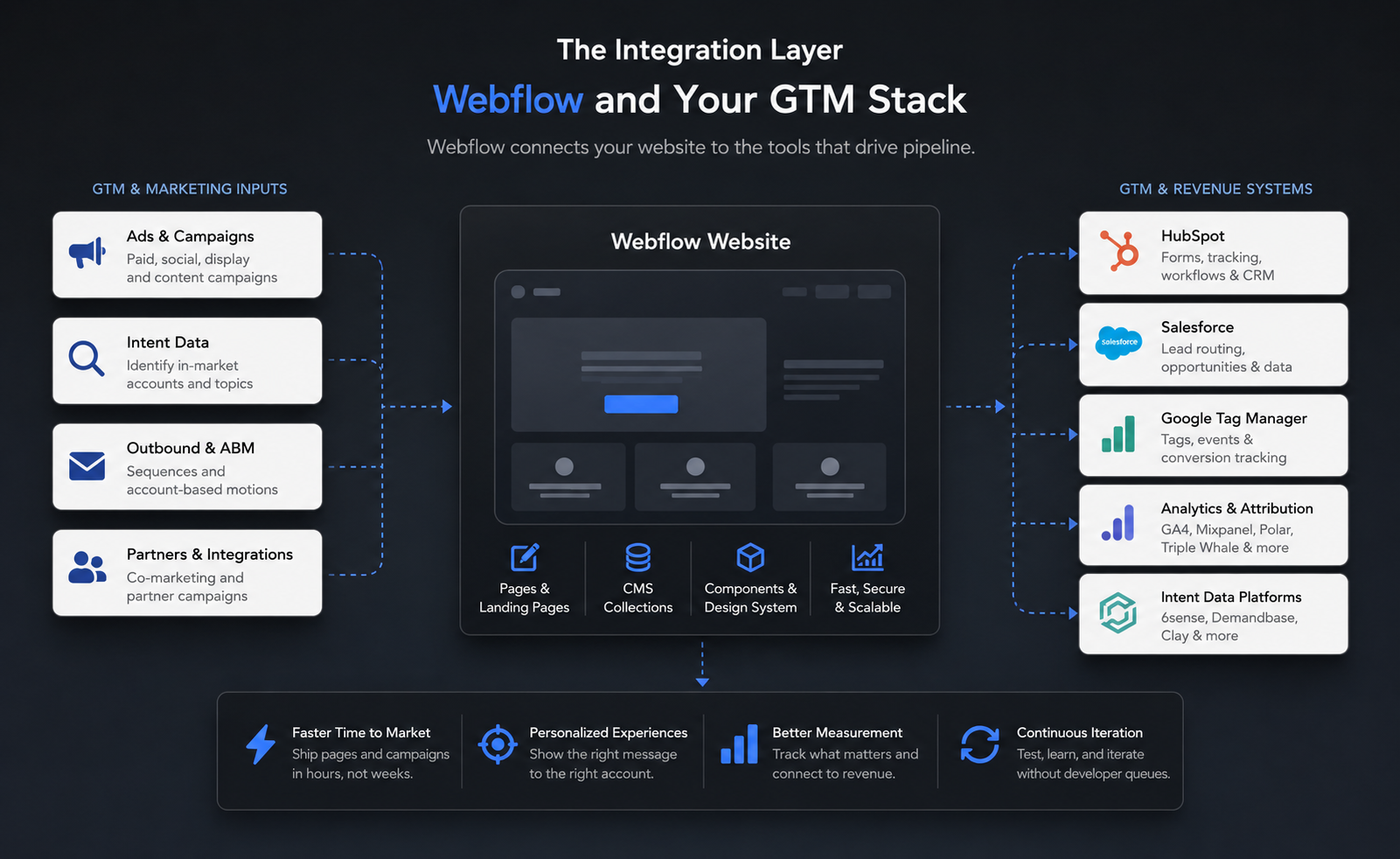
The argument for Webflow as GTM infrastructure is strongest when you consider how it connects to the tools B2B revenue teams actually use.
HubSpot and Salesforce forms embed cleanly into Webflow pages. Lead data routes into the right workflows, triggers the right sequences, and feeds into reporting with full attribution. The website does not create a gap between where a prospect first converts and where that conversion registers in your CRM.
Intent data platforms - the tools that tell you which companies are researching your category right now - can be layered into Webflow pages to enable dynamic personalization. When a high-intent visitor from a target account lands on your site, that signal can influence what they see.
Google Tag Manager - the tag management layer that sits between your website and your analytics, advertising, and attribution tools - integrates directly with Webflow. Every tracking requirement your revenue team has can be instrumented through GTM without touching the underlying site code.
The result is a website that is not a separate system your GTM team works around. It’s a live part of the GTM stack - instrumented, integrated, and updateable at the speed your go-to-market motion needs.
What This Requires to Work
There is an honest version of this conversation and then there is the version where every problem disappears with the right platform choice. This is the honest version.
Webflow as GTM infrastructure only works if a few things are true.
The site needs to be built the right way from the start. A Webflow build that was designed primarily for visual impact, without a proper CMS architecture, a scalable component library, or a logical page structure, does not give a marketing team the operational leverage described above. The infrastructure metaphor only holds if the foundations are right.
Marketing needs to actually own the website operationally. This means someone on the team - a growth marketer, a content lead, a demand gen manager - is responsible for the site the way a RevOps leader is responsible for the CRM. Webflow enables marketing ownership - it does not create it automatically.
The agency or partner who builds it needs to understand GTM, not just design. A beautiful Webflow build that is not structured for ongoing iteration, CMS-driven content, or stack integration is still a project, not infrastructure. The right partner builds for how the site will be used six months and two years from now, not just how it will look on launch day.
The Revenue Surface
The best B2B SaaS GTM teams don’t have a website. They have a revenue surface - a web presence that is integrated with their stack, responsive to their pipeline motion, and fast enough to keep pace with how their go-to-market strategy actually evolves.
Webflow has become the platform of choice for that model because it closes the gap between what revenue teams need to do and what their web infrastructure can actually support. The bottleneck between strategy and execution - the one that lives in the development queue - is removed.
The companies in 2026 that are generating consistent pipeline across paid, organic, outbound, and product-led channels share one characteristic: they do not treat any part of their GTM stack as a set-and-forget system. The website is not the exception to that rule. It’s one of the most important places to apply it.
FAQs
Yes, specifically because of how it fits the GTM workflows SaaS marketing teams actually run. Unlike WordPress, which requires plugins and developer involvement for most meaningful changes, or HubSpot CMS, which ties you to their ecosystem, Webflow gives marketing teams direct control over pages, content, and iterations without engineering dependency. For B2B SaaS companies where messaging, ICPs, and campaigns shift frequently, that operational speed is the real advantage.
A website treated as a project gets built, launched, and gradually ignored. A website treated as GTM infrastructure is maintained, measured, and iterated on continuously - the same way you'd treat your CRM or your outbound tooling. The practical difference shows up in ownership (marketing vs nobody), update speed (hours vs weeks), and measurement (pipeline and revenue vs pageviews). Most SaaS companies are running the project model without realizing it.
Yes, cleanly. HubSpot forms and tracking embed directly into Webflow without custom development. Salesforce integrates via native connectors or lightweight middleware. Intent data platforms like Clay can be layered in to enable personalization based on who is visiting and what they are researching. The result is a website that feeds your CRM, fires your workflows, and connects to your attribution stack - not one that sits outside it.
Programmatic SEO means using Webflow's CMS to build structured page templates that scale across hundreds of URL variations - use cases, industries, competitors, integrations - without designing or coding each page individually. For B2B SaaS companies with a broad ICP or multi-use-case product, this turns organic search into a genuine pipeline channel rather than a content side project. Each page targets a specific search query and routes converting visitors into the same GTM motion as paid and outbound.
The most important thing is finding a partner who understands GTM, not just design. A visually impressive Webflow build that lacks a proper CMS architecture, scalable component library, or stack integration is still a project - it just looks better. The right partner builds for how your marketing team will use the site in 12 months, not just how it will look on launch day. Ask them how they structure CMS collections, how they approach conversion architecture, and whether they have experience integrating with the tools your revenue team runs on.