
B2B SaaS teams don’t usually have a content problem. They have a scale problem. They already know the categories, use cases, industries, and integrations they want to show up for. They know the long-tail search terms buyers use when they are comparing tools, researching solutions, or narrowing down their shortlist.
What they don’t have is a system that can turn that keyword strategy into a large number of useful, structured pages without creating a mess. That’s where programmatic SEO becomes strategically valuable. Not as a shortcut for making "more pages" but as a way to build a search-driven landing page system around a repeatable content model.
Why Programmatic SEO Matters for B2B SaaS
Most B2B SaaS teams already understand that search traffic compounds over time. The problem is that the most valuable search opportunities are rarely concentrated in a handful of high-volume keywords.
They are spread across use cases, comparisons, integrations, industries, pain points, and feature combinations. A buyer may search for one of dozens of different phrases depending on what stage they are in and how they are framing the problem. That means the opportunity is not just one page ranking for one keyword. It’s a structured library of pages covering many variations of the same commercial intent.
That is why programmatic SEO is so relevant for B2B SaaS. It lets marketing teams build a repeatable template once, then scale across many pages that reflect different search intents. For example, a company can create pages for "Webflow for startups" or "Webflow for SaaS" or "Webflow CRM integration" or "Webflow comparison pages" using the same underlying system.
The result is not just more traffic. It’s more entry points into your GTM motion. And when those pages are built correctly, they can support pipeline in a way that standard blog content often cannot.
What Programmatic SEO Actually Is
Programmatic SEO is the practice of using structured data and templates to generate many pages from one repeatable pattern.
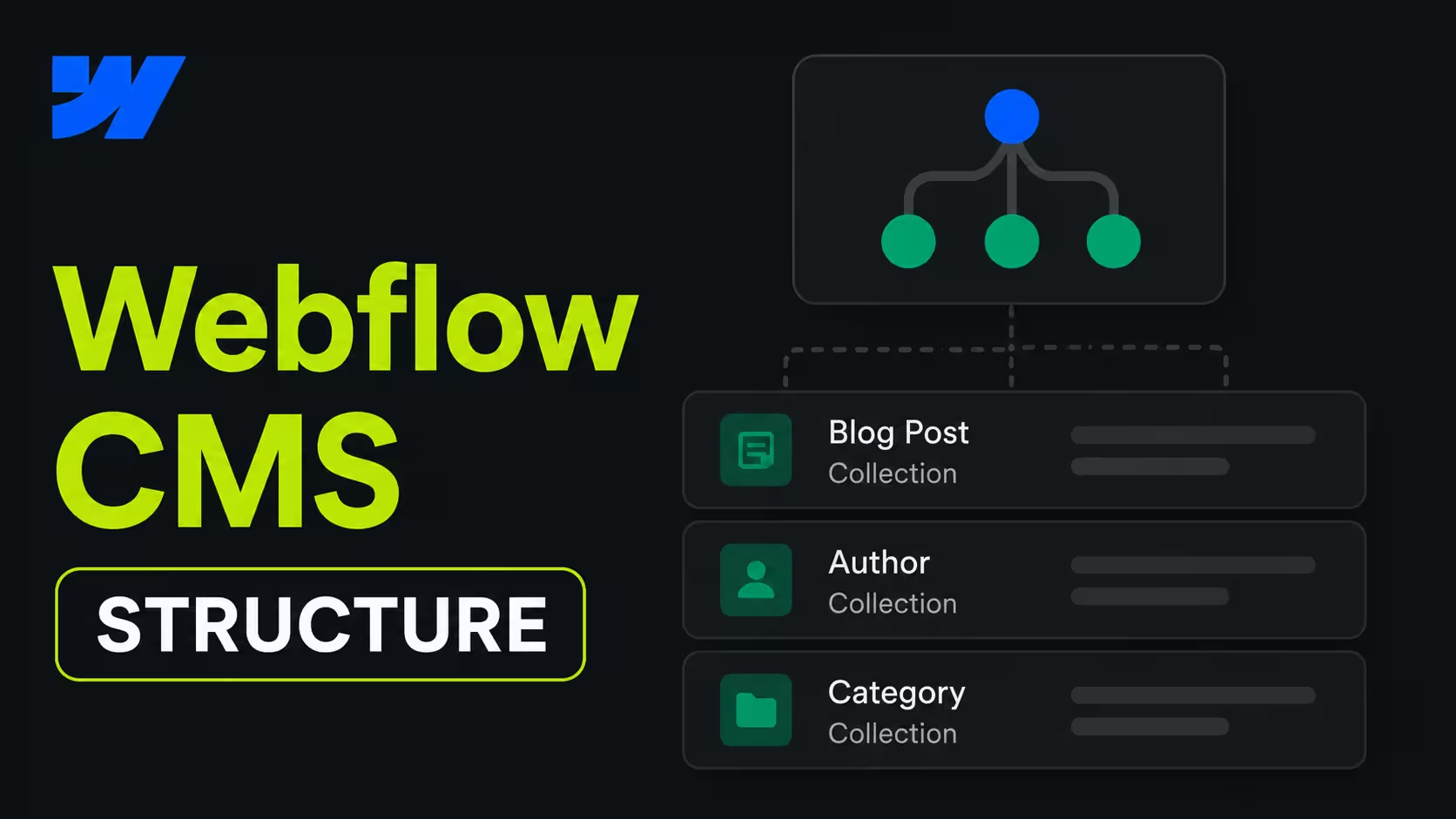
Instead of writing each page from scratch, you define the page logic once: what fields it needs, what the headline structure should be, what type of content the page should include, and how the URL should be formed. Then you populate that structure with data. In Webflow, that data usually lives in CMS Collections.
This is what makes programmatic SEO different from simply publishing a lot of content. You are not manually creating isolated pages. You are designing a system that can scale across many variations without requiring a new design or build every time.
For B2B SaaS teams, this matters because the content opportunity is often much broader than the team’s capacity to handcraft pages one by one. Programmatic SEO turns that mismatch into an advantage.
Why Webflow Is a Strong Fit
Webflow is not the only platform that can support programmatic SEO, but it’s one of the best fits for marketing teams that need speed and control without building a custom system from scratch.
The main advantage is that Webflow CMS lets you create structured page templates that are easy for marketing to manage. Once the CMS architecture is set, you can build repeatable layouts for comparison pages, use case pages, integration pages, industry pages, and location-style pages if relevant to the business.
That matters because B2B SaaS programmatic SEO only works when the content system is both scalable and editable. If the team needs engineering help every time a page template changes, the whole model becomes fragile. Webflow makes it possible for marketers to own the system after launch without turning every page into a development request.
It also helps that Webflow gives you cleaner control over SEO basics like metadata, URL structure, internal linking, schema, and page performance. Those are not optional in a programmatic model. They are what separate a usable system from a search spam factory.
Where Programmatic SEO Works Best
Programmatic SEO is most effective when the site has a clear repeatable pattern and enough meaningful data to populate it.
In B2B SaaS, the most common use cases include:
- Integration pages.
- Use case pages.
- Industry-specific landing pages.
- Comparison pages.
- Feature-to-feature pages.
- Solution pages targeted at different buyer problems.
These page types work because they map to commercial search intent. A buyer searching for "X vs Y" or "best tool for [specific use case]" is usually closer to a decision than someone reading a general blog post. If your site can answer those searches with high-quality pages, you create more routes into the conversion funnel.
The important distinction is that programmatic SEO is not about volume alone. It works when each page answers a real question with enough specificity to be useful. If the page is just a templated variation with swapped nouns, it will not rank for long.
What Makes a Good Programmatic Page
A strong programmatic page is not just a template with dynamic text. It needs a clear reason to exist.
The best pages usually include a strong headline tied to the search intent, a concise explanation of the problem, evidence or context that makes the page credible, and a conversion path that matches the intent of the visitor. A comparison page should help someone choose. A use case page should help someone understand fit. An integration page should show how the product connects to the rest of the stack.
In other words, the page needs to be useful before it’s scalable.
That is where many teams get it wrong. They start with the scale idea and forget the utility layer. Search engines are increasingly good at identifying thin content, repetitive structures, and pages that do not add much value. If the page exists only because the template allowed it to exist, it probably will not sustain rankings.
How Webflow Supports the System
The practical strength of Webflow is that it lets you build this system inside a single environment.
You can create CMS collections for pages, populate fields like title, description, target keyword, intro, proof points, CTA copy, and schema data, and then connect those fields to a template. Once the structure is right, publishing a new page becomes a content operation instead of a design project.
That makes it much easier to manage a programmatic SEO strategy without turning the website into a custom application. For scale-up marketing teams, that’s a serious advantage. You get enough structure to scale, but you do not inherit the complexity of maintaining a custom-built development layer.
It also means the marketing team can keep improving the system over time. If one page pattern outperforms another, the template can evolve. If the business changes its positioning, the collection structure can change with it. That flexibility is critical in B2B SaaS, where messaging and product packaging rarely stay fixed for long.
Common Mistakes to Avoid
The most common mistake is building pages at scale before the underlying pattern is strong enough.
If the content is thin, repetitive, or too loosely connected to real search intent, the whole program will underperform. Search engines don’t reward volume for its own sake. They reward relevance, usefulness, and structure. That means the template has to be grounded in actual buyer behavior.
The second mistake is creating pages without a content model. If different page types are all forced into one collection because it feels faster, the system becomes hard to maintain. Webflow can support structured scaling, but only if the CMS architecture reflects the page logic correctly.
The third mistake is treating programmatic SEO as a one-time launch project. It is not. It needs monitoring, internal linking, content refinement, and occasional pruning. Pages that do not perform should be improved or removed. Pages that do perform should be reinforced with internal links, supporting content, and stronger conversion paths.
The final mistake is ignoring the commercial intent of the page. A page can rank and still fail to contribute to pipeline if it doesn’t make the next step obvious. For B2B SaaS, that is the difference between traffic and value.
When Programmatic SEO Makes Sense
Programmatic SEO makes sense when the business has repeated search patterns and enough content structure to support them.
It’s usually a strong fit when:
- The product has multiple use cases.
- The product integrates with other tools.
- The category has comparison-driven demand.
- The business serves several industries or segments.
- The team wants organic traffic beyond a handful of blog posts.
If the company is still figuring out its core positioning, it may be too early. Programmatic SEO works best when the messaging foundation is already reasonably clear. Otherwise, you risk scaling the wrong structure.
That’s why the best time to build it is often after the site’s positioning and CMS architecture are stable, not before. The system should amplify clarity, not hide confusion.
Strategic Takeaway
Programmatic SEO is not just a content tactic. It’s a way to turn search demand into a repeatable website system.
For B2B SaaS companies, Webflow is a strong platform for doing that because it gives marketing teams enough structure to scale and enough control to keep iterating. When the CMS architecture is built around intent, and the pages are genuinely useful, programmatic SEO can become one of the most efficient organic growth channels in the stack.
The companies that win with it are not the ones publishing the most pages. They are the ones building the clearest system.
FAQs
Programmatic SEO in Webflow means using CMS collections and templates to generate many pages from one structured content model. It’s most useful when the page type repeats cleanly and the underlying data can be populated in a consistent way. That makes it a strong fit for things like integrations, comparisons, use cases, and industry pages. The focus is not on volume alone, but on building a repeatable system that matches real search demand.
It makes sense when your category has lots of long-tail search variation and the team needs more organic entry points than a blog alone can provide. For B2B SaaS, that usually means multiple use cases, competitors, integrations, or buyer segments that all search differently. If the product only has one obvious keyword cluster, programmatic SEO is probably premature. If the demand is fragmented across many commercial intents, it becomes a much stronger growth lever.
The best page types are the ones with a naturally repeatable structure and a clear commercial intent. Comparison pages, integration pages, use case pages, solution pages, and industry-specific pages are usually the strongest candidates. They work because each page can follow the same logic while still answering a distinct query. If the page type cannot be templated without losing usefulness, it probably should not be programmatic.
Programmatic SEO can support GEO when the pages are structured to answer specific questions clearly and consistently. AI search systems tend to favor content that is easy to parse, well organized, and tightly matched to a query. That means your template, headings, schema, and supporting copy all matter, not just the keyword in the URL. Done well, a programmatic page library gives you more chances to be cited or surfaced in AI-generated answers.
Yes, especially when programmatic SEO is part of a broader website system rather than a standalone experiment. At Designbase, this usually fits into a Strategy-First Relaunch or a GTM-focused Webflow build, because the architecture needs to support positioning and conversion as well as search. In some cases, the same CMS foundation can also power personalized landing pages for ABM or outbound, which is where our Clay + Webflow work becomes useful. The goal is a system that supports organic visibility, marketing ownership, and pipeline - not just more indexed pages.