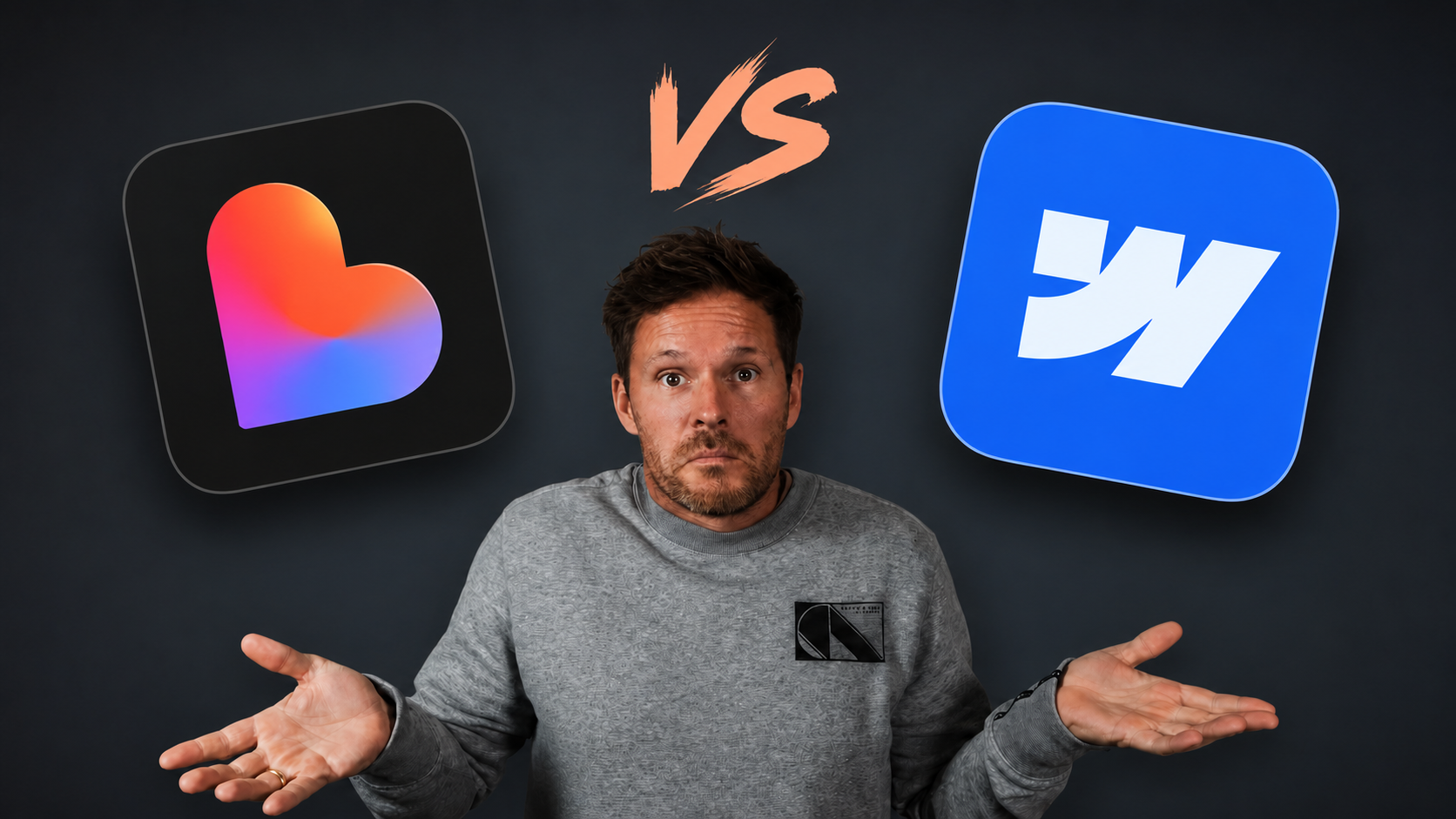
Most teams don't start by asking whether they need Lovable or Webflow. They start with a deadline. They need a website live, a campaign page published, a redesign shipped, or a product story clarified fast. In that moment, an AI website builder like Lovable looks like a very good answer. It promises no-code AI web development and a quick start.
That's the appeal. But B2B SaaS websites are not judged on how fast they are generated. They are judged on whether they can support demand generation, SEO, content, and ongoing growth without collapsing into a maintenance problem.
That's where the difference between Lovable and Webflow becomes strategic.
Quick Answer: Lovable or Webflow?
Choose Lovable if you need to move quickly with a prototype, MVP, temporary website, or functional product experiment.
Choose Webflow if you need a scalable marketing website with strong design control, CMS content, SEO structure, reusable landing pages, and ongoing marketing ownership.
The simplest way to put it is like this: Lovable helps you launch quickly. Webflow helps you operate a serious marketing website over time.
Why This Comparison Matters
The best platform for building a marketing website is not always the fastest one. It's the one that keeps working when your go-to-market motion gets more complex.
That's why the Lovable alternative conversation matters. Lovable is attractive when you want speed, but speed without structure often creates a ceiling.
The moment you need a proper CMS, a more scalable content strategy, or tighter control over SEO and page architecture, the weaknesses show up.
For B2B SaaS teams, the website is not decoration. It's a huge part of the revenue engine.
The landing pages, comparisons, use case pages, and product pages all need to support pipeline. If the platform makes that harder, it becomes a hidden tax on growth.
That is the real reason this comparison matters. It's not about whether the site looks good on day one, but whether the platform can support the next 12 months of execution.
What Is Lovable Good At?
Lovable is useful when the problem is speed and the scope is narrow.
If you need to validate an idea, get a basic site online, test a product narrative, or create a temporary campaign page, Lovable can get you moving quickly. That's why a lot of founders are drawn to it. It offers a low-friction way to create a website without the usual build cycle.
In that sense, Lovable website builder workflows are appealing for early-stage teams. You can move fast, reduce time to first version, and avoid over-investing before the message is proven.
The value is real. A lot of companies stall because they overcomplicate the first version of their site. Lovable helps avoid that.
But there is a difference between a useful first draft and a system that can scale with the business.
That difference is where the trouble begins.
Is Lovable Better for AI Website Building?
Lovable is the faster option if your priority is generating a first version through AI prompts. That makes it useful for prototypes, founder-led launches, and temporary pages where speed matters more than long-term structure.
But AI generation is only one part of building a website.
Once the site needs a deeper CMS, reusable page templates, ongoing SEO work, multiple editors, and campaign support, the quality of the underlying system matters more.
That is where Webflow remains the stronger option for a serious marketing website. The initial build may require more expertise, but the result is easier to govern and develop as the company grows.
Where Does Lovable Start to Break Down?
Lovable is not usually the wrong choice because it's bad. It's the wrong choice because the website eventually needs more than generation.
The first limitation is CMS control. B2B SaaS teams need repeatable structures for landing pages, comparison pages, case studies, blog content, and campaign pages. A Lovable CMS setup may be enough for simple publishing, but it's not usually built to support a deep content architecture or a marketing team that wants to move quickly without rebuilding pages.
The second limitation is page governance. Marketing teams need reusable sections, predictable templates, and clear ownership over the site. If every meaningful edit depends on regeneration or manual rework, the website becomes harder to manage as the team grows.
The third limitation is SEO. AI-generated pages can look fine, but ranking is not just about appearance. You need metadata control, internal linking, structured hierarchy, crawlable content, and a page system that supports long-term optimization.
That's where Webflow vs Lovable starts to become a very practical and relevant comparison.
The fourth limitation is integration. The website needs to connect cleanly to the GTM stack. HubSpot, Salesforce, Clay, analytics, attribution, and tracking all matter. If the platform makes that work awkward, marketing loses speed later even if it gained speed at the start.
The fifth limitation is team collaboration. AI website builders are built around a single-user, generation-based workflow. That works when one person owns the site, but B2B SaaS marketing is rarely a solo operation.
When multiple people need to edit content, update pages, or work on the site at the same time, the model can become difficult to manage. Non-technical team members - like content writers, demand generation managers, or campaign leads - may find AI builders less predictable to navigate without triggering unintended changes or needing to regenerate entire sections.
The result is that the site can become a bottleneck instead of a shared asset.
Where Does Webflow Fit Better?
Webflow is not just a website builder. For B2B SaaS teams, it's closer to the operating system for the marketing website.
It gives you control over CMS structure, modular components, SEO settings, and page templates. That means the team can launch new pages, update content, and evolve messaging without waiting for engineering on every change.
That matters because B2B SaaS websites are rarely static. They grow through product launches, campaign experiments, content strategy, and segmentation. Webflow is designed for that kind of ongoing motion.
It also fits better with the rest of the stack. A Webflow site can be connected to forms, CRM flows, analytics, and automation without becoming a messy custom build.
For teams that care about speed, control, and scaling a marketing website, that combination is hard to beat.
This is why the question is not really whether Lovable is impressive. It's whether Lovable can remain useful when the company becomes more complex.
Which Is Better for Building a Product?
If you are building the product itself, Lovable is usually the more relevant option. It's better suited to functional experiences where users interact with data, workflows, accounts, or application logic.
If you are building the website that explains and sells the product, Webflow is usually the better fit. It gives marketing teams more control over landing pages, CMS content, SEO structure, comparison pages, and ongoing website updates.
That distinction is important. A SaaS company may use Lovable for an early product prototype and Webflow for the public marketing website. The two platforms do not necessarily need to compete for the same job.
Lovable vs Webflow for B2B SaaS
The simplest way to compare them is by the job each platform is actually doing.
Lovable is the better answer if you are trying to move fast with minimal setup. Webflow is the better answer if you need a website that supports ongoing marketing operations.
That distinction matters more than feature lists. A platform can be fast and still be the wrong long-term choice if it cannot support the actual work your team needs to do.
The Real Decision for Founders
For founders, the question is usually not:
"Should we use AI or Webflow?"
It is almost every time:
"How long do we expect this site to carry the business before a rebuild?"
If you are pre-launch, testing positioning, or validating a simple idea, Lovable may be the right temporary choice. You want something live, something usable, and something that reduces friction.
But if the website already needs to help drive demand, support a real content strategy, or act as the face of a growing SaaS business, Webflow is the safer decision. You are not just building a page. You are building a marketing asset.
That's why many teams start with AI tools and then migrate. The early need is speed. The later need is structure.
Which Is Cheaper: Lovable or Webflow?
There is no universal answer because the total cost depends on what you are building and how long you plan to use it.
Lovable may be cheaper for testing an early product idea or creating a short-lived first version. Webflow may offer better long-term value when the website needs CMS content, SEO, landing pages, integrations, and continuous marketing work.
The important comparison is not only the monthly platform fee. You should also consider build time, maintenance, content operations, integrations, and the cost of rebuilding the site later if the initial platform cannot support the business.
When Lovable Makes Sense
Lovable makes sense when the use case is temporary, experimental, or very early.
Use it if you need:
- A quick validation site.
- A short-lived campaign page.
- A founder-led launch page.
- A simple web presence without much content depth.
- A fast way to test messaging before a bigger build.
In those cases, Lovable can be the right call. It removes friction and gets something out the door fast.
What it should not be mistaken for is a full replacement for a scalable SaaS website. If the business is already thinking about content operations, comparison pages, programmatic SEO, or marketing ownership, the ceiling will show quickly.
When Webflow Is the Better Option
Webflow makes sense when the website is a core growth asset.
Use it if you need:
- A CMS that marketing actually owns.
- A modular page system for landing pages and campaigns.
- Better SEO structure and long-term content management.
- A website that integrates into the rest of your GTM stack.
- A platform that can support scaling without constant rebuilds.
That's why Webflow is often the better choice for funded founders, CMOs, and growth teams. The site is not just there to explain the product. It has to support acquisition, conversion, and iteration.
The more your business depends on website execution, the more Webflow makes sense.
The Right Fit for the Stage You're In
Lovable and Webflow are not really competing to solve the same problem.
Lovable is the better choice when the website is still in validation mode. It helps you move fast, test messaging, and get something live without overbuilding too early. That makes sense for founders who need speed and flexibility more than structure.
Webflow becomes the better choice when the website has to behave like part of the GTM system. At that point, the business needs a CMS the team actually owns, a page system that can scale, cleaner SEO control, and a setup that doesn't slow marketing down every time something changes.
That's the real distinction.
Lovable helps you launch. Webflow helps you operate.
If the site is still just a test, Lovable can be enough. If it's becoming a core growth asset, Webflow is the more durable choice.
FAQs
Lovable is better for prototypes, MVPs, temporary websites, and fast product experiments, while Webflow is usually better for a scalable B2B SaaS marketing website with CMS content, SEO control, reusable landing pages, and ongoing marketing operations.
Yes, Webflow is usually better for B2B SaaS websites because it gives marketing teams more control over CMS content, landing pages, comparison pages, SEO structure, reusable components, and ongoing website updates.
Lovable can build a working website quickly, but Webflow is usually the stronger choice when the site needs a deeper CMS, reusable page templates, ongoing SEO work, multiple editors, marketing integrations, and long-term content operations.
Yes. A SaaS company can use Lovable to prototype a product or validate an idea and Webflow to build and manage the public marketing website. The platforms can complement each other because Lovable is suited to functional product experiments, while Webflow is suited to structured marketing and content operations.
Lovable may be cheaper for a short-term prototype, temporary page, or early validation project, while Webflow may offer better long-term value when the website needs CMS content, SEO, landing pages, integrations, and continuous marketing work. The total cost should include maintenance, content operations, integrations, and the potential cost of rebuilding later.