Squarespace and Webflow solve two different problems. Squarespace gets a polished website live fast with almost no setup, while Webflow trades a steeper learning curve for far more control over structure, performance, and growth. For teams that care about design quality and long-term flexibility, that difference matters immediately.
Choosing between them is really a decision about time horizon: do you want the fastest path to “done” or a platform your website won’t outgrow in two years? This comparison uses 2026 pricing data, independent SEO benchmarking, and real usage patterns to answer that question with evidence rather than opinion.
Why This Comparison Needs Data, Not Opinions
Most Squarespace vs Webflow articles repeat the same surface-level claims: Squarespace is easier, Webflow is more powerful. That’s directionally true but not really useful for an actual, researched decision.
What matters more is what happens after launch - how much the site costs once you add real usage, how it performs in search, and how painful it becomes to change direction later. Those are measurable, and 2026 data on both platforms gives a clearer picture than template screenshots ever could.
What It Means for Marketing Teams
Squarespace is built around guided design: pick a template, fill in blocks, publish. That workflow is genuinely fast for anyone who does not want to think about layout systems or CMS structure.
Webflow gives marketing teams a visual canvas with real control over grid systems, CMS collections, interactions, and page-level SEO fields. That extra control means more setup time upfront, but it pays off once a team needs to publish more pages, run more campaigns, or adjust design without waiting on outside help.
The practical difference: Squarespace optimizes for the first six months, Webflow optimizes for the next years.
Pricing Comparison in 2026
On paper, Squarespace looks cheaper. Its Personal plan starts around $16/month, compared to Webflow's paid tiers starting near $18/month, though Webflow also offers a genuinely usable free tier that Squarespace does not. [web:386]
The advertised prices are not the full story. A cost analysis in 2026 found Webflow’s true monthly cost, once CMS item overages, form submission limits, and bandwidth charges are factored in, averages around $74/month, while Squarespace’s true cost averages around $133/month due to transaction fees, scheduling add-ons, email campaign add-ons, and contributor limits.
That’s a meaningful reversal from the sticker price. Squarespace’s advertised plans are cheaper, but its list of hidden fees is longer and more expensive in practice, especially for any site doing e-commerce or managing multiple contributors.
Advertised pricing is close once you compare equivalent tiers, but the true-cost gap opens up specifically around CMS limits, contributor seats, and transaction fees. That gap matters more the longer a business plans to run its website.
SEO and Technical Performance
This is the area with the clearest data. An independent CMS SEO comparison analyzing 584 pages across three live websites found Webflow scoring 73.3/100 on overall SEO versus 57.1/100 for Squarespace.
The gap is largest in structured data adoption: 82.2% of Webflow pages carried structured data markup compared to just 66.7% of Squarespace pages in the same study. Webflow pages also averaged 56 internal links per page compared to 10 for Squarespace, and loaded faster on Largest Contentful Paint (7.02 seconds vs 11.18 seconds).
Squarespace’s one clear advantage in this dataset is content readability, likely a result of its simpler block-based writing flow. On every structural and technical SEO measure, Webflow’s output was stronger, which matters directly for organic visibility and increasingly for how AI answer engines parse and cite a page.
Design Flexibility and Templates
Squarespace’s templates are polished out of the box and require little effort to make them presentable, which is exactly why it remains popular with users like photographers, consultants, and small service businesses.
Webflow ships with far fewer default templates but compensates with a design canvas that has no actual ceiling - spacing, breakpoints, interactions, and CMS-driven layouts are all fully editable. Webflow gets the edge on customization exactly because nothing is locked to a template structure.
The trade-off is real: Squarespace gives you a good-looking site with less effort, while Webflow gives you a site that can look like anything you want, provided you or a partner puts in the setup work.
Webflow’s Market Position in 2026
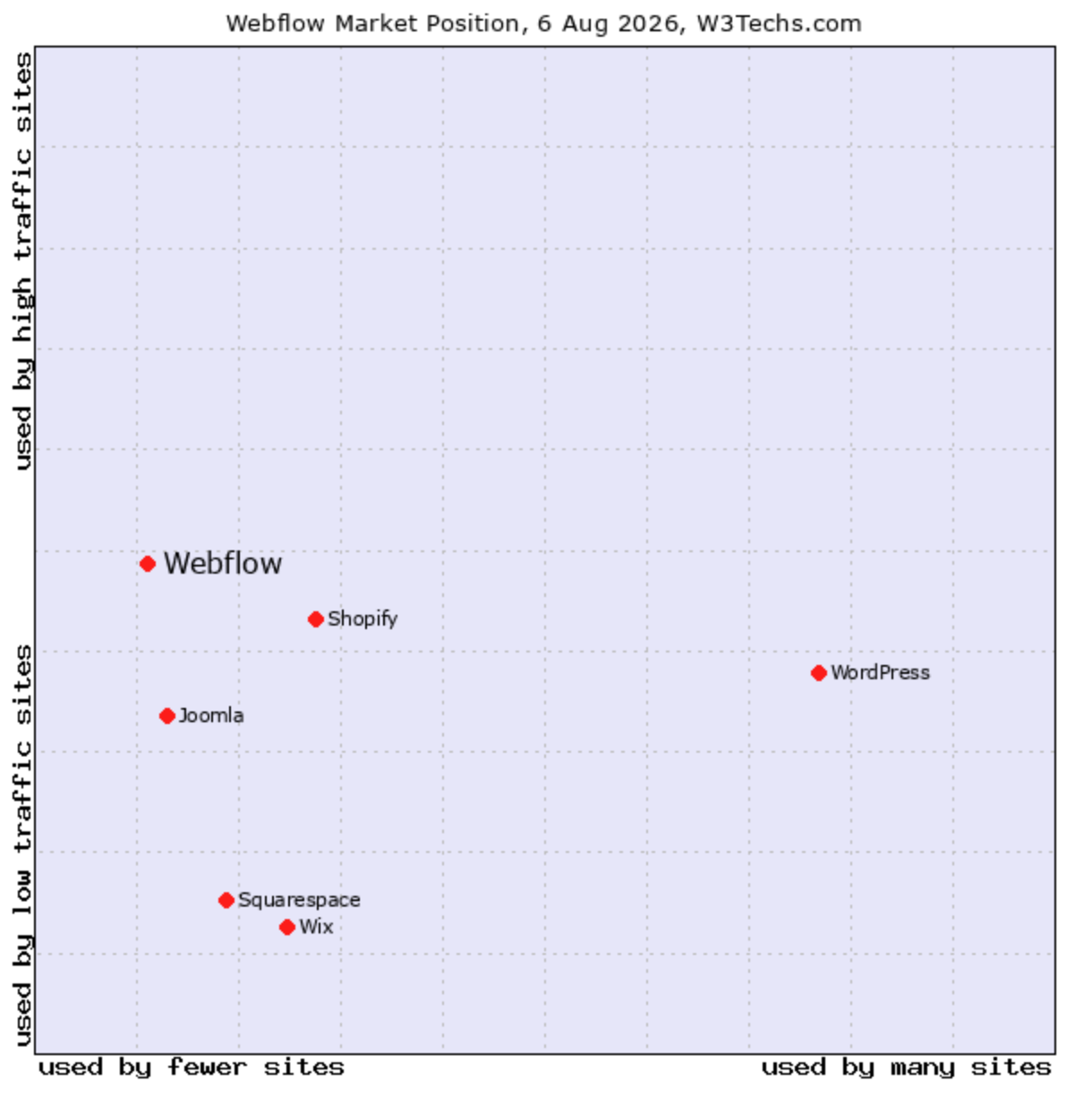
The market data suggests Webflow is used by fewer sites overall than mass-market builders, but it shows up more often on higher-traffic sites, which is a strong signal for businesses that care about performance and long-term site quality.
Squarespace sits much lower on the traffic axis, which fits its role as a more design-led, simpler publishing platform rather than a system for more demanding marketing websites.
In practical terms, that means Webflow is the better fit when the website needs to support deeper content structure, stronger editorial control, and a more serious marketing role.
Squarespace is still a good choice for smaller sites that value simplicity and aesthetics, but the graph suggests it is less often the platform behind the sites that are doing more of the heavy lifting.
Looking ahead, the trend likely favors Webflow for companies that want the site to grow with the business, while Squarespace remains a strong option for lighter-weight brand sites that do not need as much structural flexibility.
Ecommerce and Scaling Content
Both platforms support ecommerce, but they scale differently. Squarespace’s commerce plans include built-in transaction fees on lower tiers and CMS/contributor limits that businesses tend to hit as they grow, based on documented plan restrictions.
Webflow’s CMS plans also cap item counts (roughly 2,000 items on the CMS plan, rising to 10,000 on Business), and forms and bandwidth have their own thresholds, but the ceilings sit higher and the platform is generally regarded as the stronger choice once a site needs deep content structure or non-standard product logic.
For a five-page portfolio site, none of this really matters. For a site expected to publish regularly, add languages, or expand its catalog, the differences start to matter within the first year already.
Which Platform Is Better for Which Business
Our honest take: Squarespace wins on simplicity and short-term cost for small, static sites. Webflow wins almost everywhere a business expects to grow, publish more, or care about long-term SEO performance.
The Real Trade-Off in 2026
You shouldn’t look at Webflow vs Squarespace as “hard” vs “easy”, but by what you need your website to do over time. Squarespace is better for getting a simple site live quickly, while Webflow makes more sense for businesses that expect to grow, publish more, and need stronger control over structure, SEO, and long-term flexibility.
That trade-off is important to understand in 2026 because technical foundations now influence not just Google rankings, but also how AI systems parse and surface content. With stronger structured data adoption, denser internal linking, and better Core Web Vitals in independent benchmarking, Webflow is the superior long-term fit for companies that want their website to keep performing as the business grows.
FAQs
Yes - based on independent 2026 data across 584 pages (just one of the many researches), Webflow scored higher on overall SEO (73.3 vs 57.1), structured data adoption (82.2% vs 66.7%), and page speed.
Advertised pricing is close, but once hidden fees like transaction charges, CMS overages, and contributor limits are included, Squarespace’s true monthly cost has been measured higher than Webflow’s in 2026 cost analyses.
Squarespace is usually the faster, simpler choice for a small, static site. Webflow is better if the business plans to grow content, run campaigns, or invest more in design over time.
Yes, and many growing businesses do exactly this once they hit CMS or design limitations. But migrating earlier is generally less disruptive than waiting until the site has outgrown its structure.
Webflow, based on higher CMS item ceilings, stronger internal linking patterns, and better structured data adoption in independent testing.