Webflow is the better choice for established, design-conscious businesses that care about long-term control, structured content, and a website that can evolve with the company, while Wix is the better choice for teams that want speed, simplicity, and a more bundled setup from day one.
That trade-off matters more in 2026 because both platforms now include AI-assisted setup, stronger template systems, and enough core features to launch a credible site fast. The real difference shows up after launch, when the site has to support ongoing updates, stronger SEO, better brand presentation, and a team that cannot afford to depend on experts all the time.
What Each Platform Is Really Optimized For
Wix is optimized for reducing friction. It’s designed to help non-technical users move quickly from blank page to working site with templates, guided flows, app integrations, and AI-assisted setup.
Webflow is optimized for control. It gives teams stronger command over layout, CMS structure, visual systems, and page-level execution, which matters more once the website is treated as part of a larger growth engine rather than a one-time project.
That difference is exactly why the comparison should not be reduced to “beginner tool versus advanced tool” - a better framing is “launch convenience versus long-term adaptability” for example. For many businesses, the right answer depends on whether the website is expected to stay simple or become a more important part of brand credibility and day-to-day marketing work.
Website Ownership and Day-To-Day Management
This is one of the most important differences. Many established businesses don’t have deep in-house technical support for their website, but they still need the site to evolve regularly as services, pages, campaigns, and messaging change.
Wix makes day-to-day editing easier for general users because the environment is more guided and bundled. For smaller teams with straightforward needs, that can be a genuine advantage.
Webflow asks for more intention upfront, but it often creates a better long-term editing and management setup once the system is structured properly. That matters for the operational marketing person or small marketing team who needs control, but does not want to depend on a rotating mix of freelancers, patchwork fixes, or slow external support every time the website needs attention.
What the Market Position Tells Us
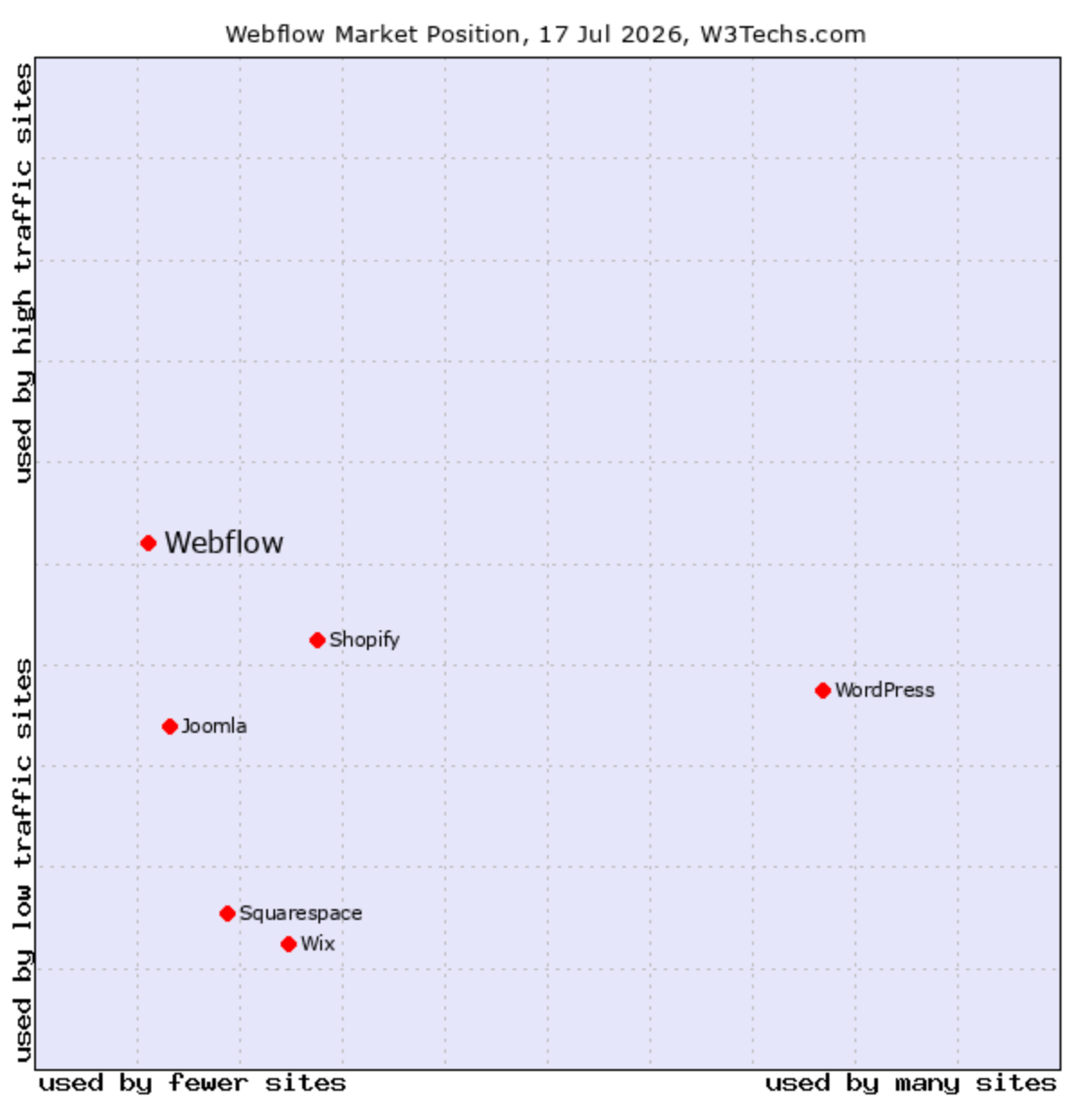
The graph suggests that Wix is widely used, but it sits lower on the high-traffic axis than Webflow, which points to a difference in website maturity. Wix works well for simpler websites and teams that want a guided setup, while Webflow appears more often in the segment where the website has to support more serious content, design, and growth requirements.
In 2026, the decision is no longer just about launch speed. For businesses with an active marketing website, the more relevant question is whether the platform can keep up as the site becomes more important, and the graph points more clearly toward Webflow in that scenario. Wix still fits teams that want speed and convenience, but Webflow fits better when the website needs to become a durable business asset.
Workflow Fit for Modern Marketing Teams
Webflow is usually the better fit for marketing teams that manage an active website because it supports a more deliberate content and design workflow. Once the initial system is set up, teams can manage landing pages, CMS-driven resources, case studies, and campaign pages with less structural compromise.
Wix is usually the better fit for leaner teams that want the site to be easy to maintain without much training and without a lot of technical overhead. It gives users more built-in tools up front, and that makes it attractive when the website is only one part of a broader operations load.
The trade-off is that Wix tends to feel stronger at the beginning, while Webflow tends to feel stronger after the team has grown into the website. For teams that value long-term marketing performance, that distinction matters more than surface ease of use.
Webflow vs Wix vs AI Builders
Webflow is not automatically better than AI builders, and Wix is not automatically the “AI choice” - the real distinction is that Wix uses AI more aggressively to simplify setup, while Webflow still expects more intentional input from the team.
That makes Wix more attractive for users who want AI to remove decision friction. It makes Webflow more attractive for businesses that want AI assistance without giving up control over layout, content structure, and future flexibility.
AI builders are most useful when they accelerate production without flattening the brand. If the output looks generic, scales poorly, or becomes hard to optimize later, the speed advantage fades quickly.
Design Quality and Brand Control
Webflow is better for design-conscious businesses because it allows a much wider range of layouts, interactions, component logic, and responsive behavior. A strong team can use it to create a site that feels branded rather than templated.
Wix has improved its design flexibility, especially through newer editors and AI-assisted workflows, but it still tends to guide users toward a more managed and opinionated setup. For many businesses that is helpful, but it also creates a ceiling sooner when the brand wants something more distinctive.
Visual credibility is not decorative. It influences trust, perceived quality, and how differentiated the company feels in competitive markets. If the website is expected to carry brand positioning, Webflow usually gives more room to express that clearly.
Pricing and Cost Logic in 2026
Wix is usually more attractive on pricing for small businesses because it bundles more functionality into a simpler all-in-one proposition. Users often feel like they are buying a site builder plus a built-in ecosystem, and that can reduce immediate tool spread.
Webflow’s pricing logic makes more sense when the site itself is the core asset and the business is already comfortable assembling a more specialized stack around it. In that case, paying for more control can be more efficient than paying for simplicity that later becomes restrictive.
The most useful way to compare pricing is by asking yourself the most important question:
“What does this business actually need?”
The most useful pricing question is not just which plan is cheaper today. It’s which platform creates less friction, less rework, and fewer structural compromises over the next several years.
SEO Comparison: Which Platform Has More Limits?
Webflow has a higher SEO ceiling for companies that plan to publish more content, shape clearer site architecture, and control technical details. That’s the short answer.
However, Wix is no longer the weak SEO option it once was. It can rank well, supports important page-level controls, and is perfectly viable for many small businesses, especially where the content model is simple and local intent matters more than deep technical execution.
The difference shows up when SEO stops being a secondary concern and becomes part of growth strategy. In that situation, Webflow usually gives teams more room to build structured resource hubs, stronger internal linking systems, more intentional content templates, and cleaner long-term content operations.
Especially for AI-driven discovery that matters because machine-readable structure, consistent schema strategy, clean hierarchy, and strong topical clustering are becoming more important. The easier it is to maintain those patterns across a large site, the more durable the platform becomes.
Migration, Relaunches, and Platform Switching
Wix makes sense when the current website still fits the business, updates are simple, and there is no major pressure to improve structure, performance, or design flexibility. Webflow makes more sense when the company wants a cleaner rebuild, better content control, and a stronger foundation for ongoing marketing activity.
A migration is not always necessary, but it becomes worth considering when the current setup slows the team down or makes the website harder to manage. When the site already feels restrictive, hard to scale, visually outdated, or dependent on too many workarounds, staying put can be more expensive than moving.
Webflow vs Wix for Established Businesses
For established businesses, the biggest issue is rarely “Can we publish a website?”
The bigger issue is whether the website can keep pace with the business as expectations rise around content quality, brand presentation, and operational efficiency.
Wix remains a sensible choice for businesses that want simplicity and don’t expect the website to become much more complex. Webflow becomes the better choice when the business wants a stronger long-term system, better editorial control, and a site that reflects a higher level of maturity.
This is especially true for companies that are already investing in positioning, visual identity, or ongoing website improvement. Once the website is part of that broader effort, flexibility and maintainability start to matter as much as launch speed.
Where Each Platform Starts to Break Down
Wix starts to feel limited when the site needs more custom structure, more distinctive design, or more controlled content architecture than a guided system handles comfortably. The convenience that helps at launch can later turn into a big problem later.
Webflow starts to feel inefficient when the team mostly needs simplicity and is not going to use the extra control it provides. If no one on the team values the design precision or CMS depth, the additional setup work can feel unnecessary.
That’s why the most useful comparison is operational. Buyers should choose the platform whose limitations they can live with, not the one that sounds best in a feature list.
Objective Recommendation by Scenario
Webflow is better for established businesses that want a long-term platform for design quality, content structure, and easier future development. Wix is better for companies that want a simpler website setup and expect the site to remain relatively straightforward.
Looking at the decision through real scenarios usually produces a better answer than debating which platform is universally better. Both platforms are capable in 2026, but they solve different levels of complexity.
It All Comes Down to Your Website
Webflow is better for businesses that see the website as a strategic growth asset, while Wix is better for businesses that primarily need a polished, easy-to-manage web presence. That’s the most direct and objective answer to Webflow vs Wix comparison when we are writing this in August 2026.
If the priority is speed, ease, and bundled convenience, Wix is the stronger choice. If the priority is design quality, structured growth, stronger SEO flexibility, and a site that is less likely to be outgrown, Webflow is the stronger choice.
The deciding question is not which platform feels easier this month. It’s whether the website is expected to remain simple, or whether it’s expected to become more important as the business grows.
FAQs
Webflow is better in 2026 for established businesses that care about design quality, website longevity, and stronger long-term control. Wix is better for businesses that value simplicity and want to stay inside a more guided all-in-one system.
Wix is easier to manage at the start because the system is more guided. Webflow can become easier to manage over time when the site is built properly and the business needs more structured control without relying on repeated outside fixes.
Webflow is usually the stronger relaunch option when the current website feels restrictive, dated, or hard to expand. It gives businesses a better foundation if they expect the site to keep evolving after launch.
A business should consider moving when the site no longer reflects the brand, when content structure is getting messy, or when the current platform is creating more compromises than convenience.
Webflow usually has the higher SEO ceiling because it offers more structural control and more flexibility for long-term content operations. Wix is still a capable choice for simpler websites with lighter SEO demands.