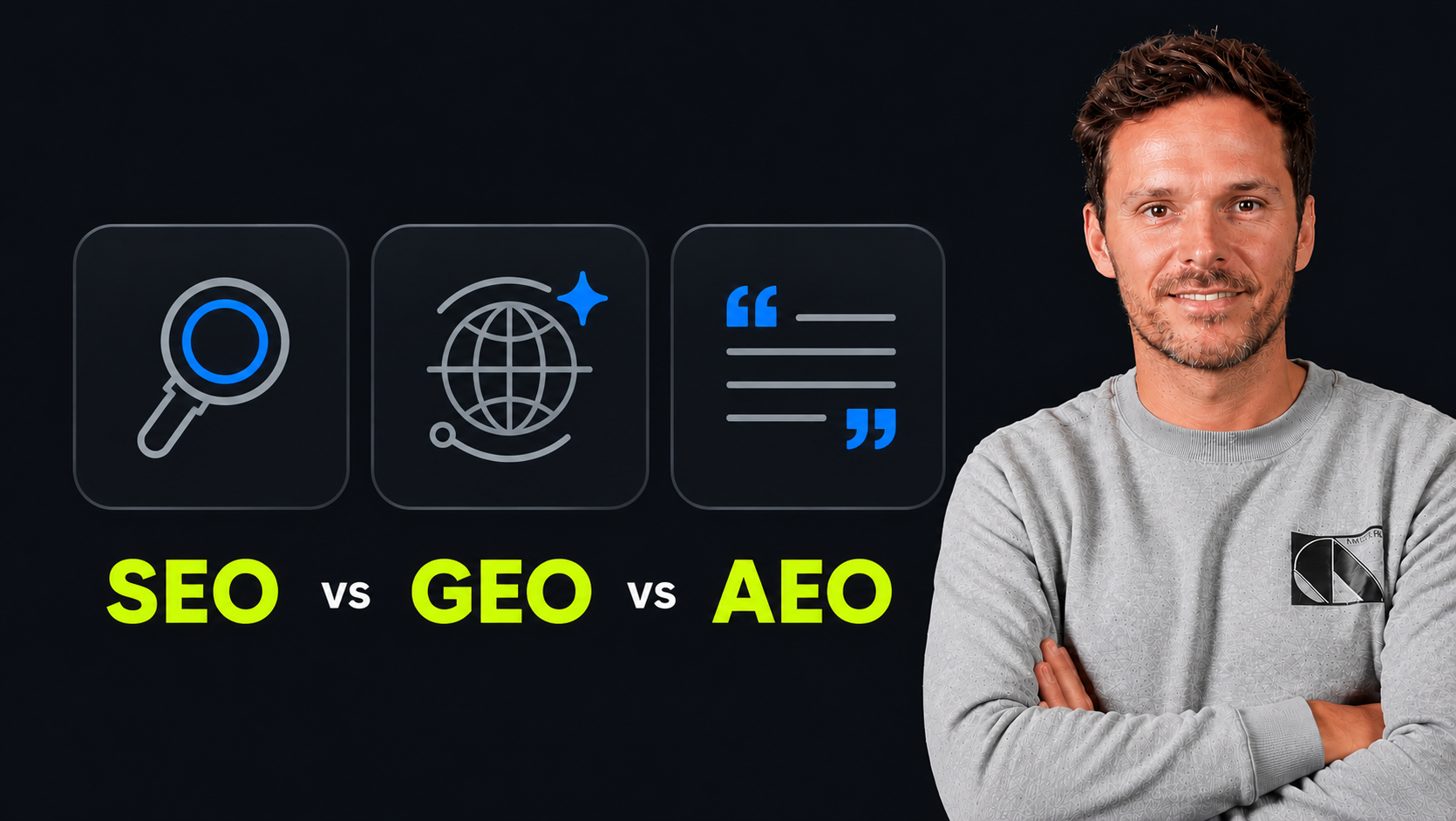
What is the difference between GEO, SEO and AEO?
They target three places where buyers find answers. SEO is about ranking in the list of results, AEO about being the answer itself, and GEO about being mentioned when AI writes the answer.
AEO is the older term. It grew out of featured snippets and voice search. GEO comes from a 2023 research paper on how content gets used by generative AI. In practice, many teams use AEO and GEO for the same thing.
In 2026, good SEO already includes AEO and GEO. All three rest on the same foundation: a site that search engines and AI tools can crawl, read and trust, with content that answers questions directly. The labels describe where your company shows up, not three separate jobs.
That’s how we run search work in our Webflow SEO Agency: technical SEO, content and visibility in answers from ChatGPT, Perplexity and Google AI Overviews in one scope, not three separate packages.
Not sure where your site stands? Our free AI-Readiness Check takes about 3 minutes and scores how ready your website, marketing setup and team are for the AI era.
What changes when buyers ask AI instead of Google?
The buyer gets a summary and a shortlist before visiting any website. If your company isn’t in that answer, you may not be on the list at all.
Clicks drop when an AI answer appears. In a Pew Research study, users clicked a traditional result on 8% of visits with an AI summary, against 15% without one. Only 1% clicked a link inside the summary.
Three things change for you:
- The goal. Being named in the answer matters as much as ranking below it.
- The sources. AI tools combine several sources into one answer. What reviews, comparisons and partner sites say about you counts, not only your own pages.
- The measurement. Rankings and traffic don’t show whether ChatGPT recommends you. You need to check the answers themselves.
What stays the same?
Almost everything technical. AI tools still need pages they can reach, read and trust.
Google states that there are no additional requirements to appear in AI Overviews or AI Mode, and no special files or markup needed. The SEO fundamentals still apply: crawlable pages, clear structure, internal links and content that answers the question.
Other AI tools work the same way at the base. If a crawler can’t read your page, no strategy fixes it. We cover the details in our separate guides:
- Why ChatGPT can’t see your website
- Whether schema markup helps you get cited by AI
- Whether your website needs an llms.txt file
What should your team do differently for GEO?
Add four habits on top of good SEO. None of them needs a new tool to start.
- Write answer-first pages with facts. Put the answer in the first sentence and back it with numbers, sources and examples. The original GEO research found that adding citations, quotes and statistics raised a source’s visibility in AI answers by up to 40%.
- Get mentioned where buyers compare. Reviews, industry lists, comparison articles and partner pages are what AI tools quote when they recommend providers. Make sure your company appears there, with current facts.
- Keep your facts consistent. Services, prices, locations and client names should match on your site, your profiles and partner pages. Conflicting facts make an AI tool less likely to name you.
- Track prompts, not only keywords. List the questions your buyers ask before they contact you, and check the answers regularly. Tools like Ahrefs Brand Radar now track this too.
Our tip: Ask ChatGPT the three questions your buyers ask before they call you, and read which sources the answer cites. If you’re not named, those sources show you where to be mentioned. If you’re named with outdated facts, start with your own pages.
Which pages do AI tools quote for B2B buyers?
The pages that answer buying questions with specifics: what you do, for whom, at what price and with what results. Blog posts help, but service and proof pages carry the recommendation.
- Service pages with a clear scope. What’s included, who it’s for, how long it takes and where prices start. A vague service page gives an AI tool nothing to quote.
- Case studies with numbers. A named client, the problem and a measurable result. Specific, checkable proof is what an answer can cite.
- Honest comparisons. Buyers ask AI to compare options. If your site explains when another option fits better, you become a source for that comparison, not just a name in it.
- FAQs from real questions. Short, direct answers to what buyers ask before they contact you, taken from sales calls and Search Console.
On most sites we take over, these facts exist but sit in PDFs, sales decks or images. Move them into the page text, where search engines and AI tools can read them.
What is real and what is just hype in GEO?
AI search really does change how buyers find providers. What’s hype is any promise that you’ll be named in the answer.
- Nobody can guarantee AI mentions. Answers change from one run to the next, even for the same prompt. Treat a guarantee as a warning sign.
- Ranking helps, but it isn’t enough. In an Ahrefs analysis of 863,000 keywords, about 38% of pages cited in AI Overviews also ranked in Google’s top 10 for the same search. That gap is why mentions on other sites matter.
- There are no shortcuts. AI-only content, special files or markup won’t buy a mention, as Google’s own guidance above shows.
- One check proves little. Run each prompt several times, logged out, before you draw conclusions.
A useful test for any GEO offer: ask how results are measured and what changed for a real client. If the answer is a dashboard score with no method behind it, keep the budget in work that also improves your SEO.
Do you need a separate GEO strategy?
No. You need one search strategy that covers both. Splitting SEO and GEO into two projects usually means two teams optimizing the same pages in different directions.
The base is the same for both: a site structure search engines and AI tools can read, and content that answers real questions. That’s why we build SEO into the structure of a site, not into reports after launch.
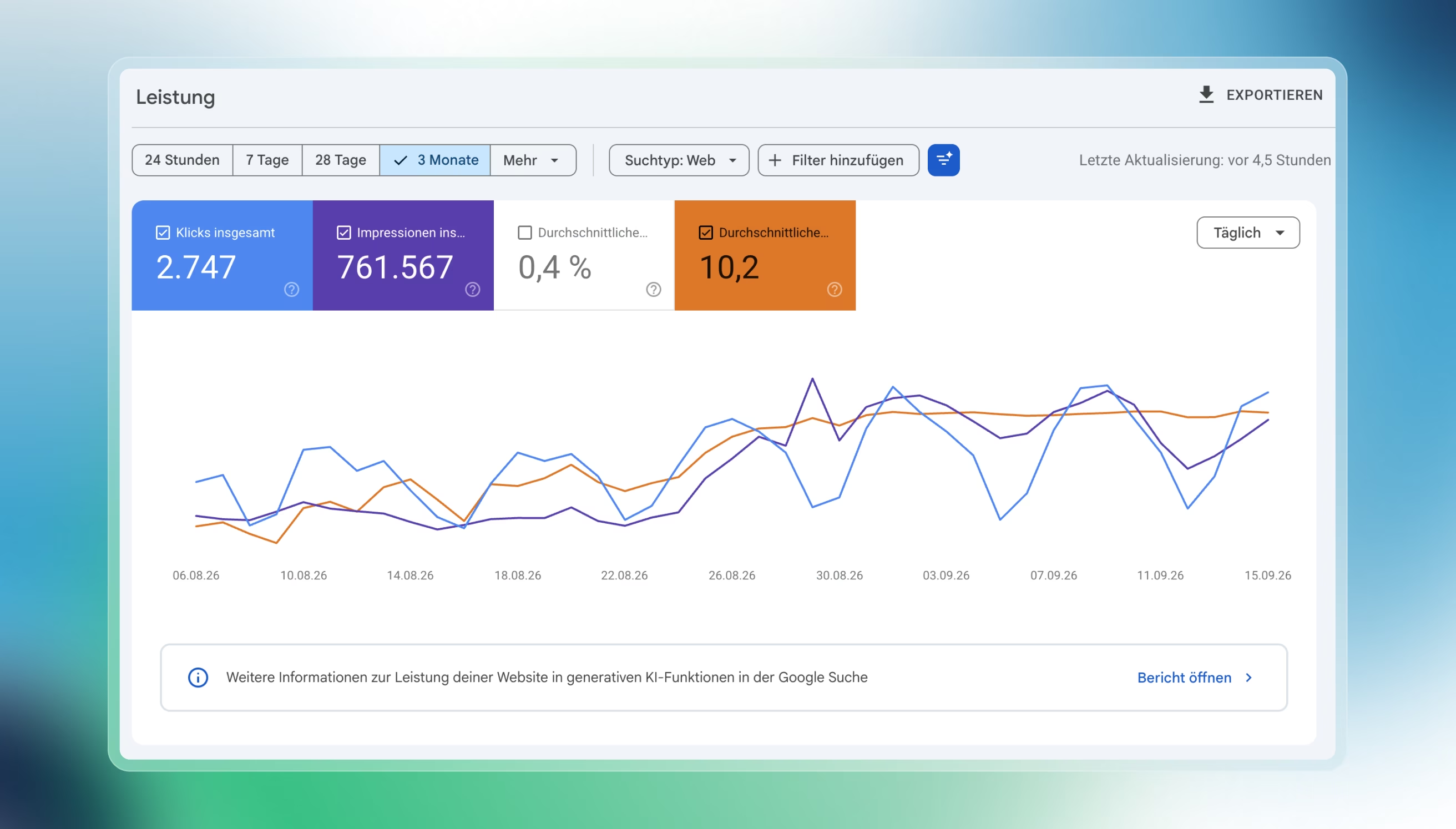
From our projects: On the heyData relaunch, we rebuilt structure, metadata and internal links page by page. After launch, daily impressions grew from 8,340 to 35,130, and the average Google position across all keywords moved from 20.7 to 7.8. Read the heyData case.
Where should your team start?
Start by checking what AI tools say about you today. Then fix the basics before you buy any GEO tool.
- Test the answers. Ask ChatGPT, Perplexity and Google the questions your buyers ask, and note who gets named.
- Fix what blocks reading. Make sure crawlers can reach your key pages and that the content is in the page, not hidden behind scripts.
- Rewrite your key pages answer-first. Start with service pages and the questions that lead to enquiries.
- Measure monthly. Track a short list of prompts next to your rankings and enquiries.
If you want one team to handle both, book a call and we’ll look at where your site stands in Google and in AI answers.
FAQs
No. GEO builds on SEO, because AI answers draw on pages that search engines can crawl and index. Most of the work is the same, with a different goal and different measurement.
Generative engine optimization. The term comes from a 2023 research paper on how content gets used in answers written by AI.
Almost. AEO is the older term, from featured snippets and voice search. GEO focuses on answers written by AI, and many teams use the two together.
By checking AI answers directly. Track which prompts mention your company, which sources get cited, and how much traffic arrives from AI tools in your analytics.
Mostly not. The same pages work for both when they answer the question first and back it with clear facts and sources.