
Most B2B SaaS websites are not broken. They are just behind. They were built for a version of the business that no longer exists. The ICP has shifted. The product has matured. The competitive landscape looks different. The messaging that made sense at Series A no longer reflects who you sell to or what you actually do.
That’s the real trigger for a website rebuild. Not that the design looks bad, but the site has simply stopped being an accurate reflection of the business. And for B2B SaaS teams where the website sits at the intersection of every GTM motion, that gap has a cost. The only question is when it becomes the right strategic move.
Why Website Redesign Is a GTM Decision, Not a Design Decision
The word redesign creates the wrong mental model. It suggests the problem is visual - that the site looks wrong, feels outdated, or needs a refresh. Sometimes that’s part of it. But for B2B SaaS companies, the more accurate frame is a SaaS website redesign or rebuild. Not an aesthetic update. A structural rebuild that aligns the site with where the business actually is.
That distinction matters because it changes how you scope it, how you resource it, and how you measure success. A design refresh can be done in a few weeks. A proper website rebuild vs redesign that touches positioning, CMS architecture, conversion logic, and GTM stack integration is a different project entirely.
For most funded founders and marketing leaders, the trigger is not "this site looks outdated" - it’s "this site is slowing us down." Every page update requires a developer. Every campaign page sits in a backlog. The messaging no longer maps to the ICP. Sales is saying something different from what the homepage says. The outbound sequence sends prospects to a page that feels generic. These are not design problems. They are go-to-market problems that happen to live on the website.
That’s when a full-service relaunch becomes the right GTM move.
The Real Cost of Not Rebuilding
Most teams underestimate what a misaligned website is costing them in slow motion.
The cost is not always visible in a single metric. It shows up in a conversion rate that never quite improves despite the campaigns. It shows up in demos where buyers arrive with the wrong expectation. It shows up in a high-intent page that ranks for the right keyword but converts at a fraction of what it should because the messaging is stale.
It also shows up in operational drag. When is it time to redesign your website becomes a repeated conversation, but the actual decision keeps getting deferred because it feels too big and too risky. So the team keeps patching - a new section here, a revised headline there - and the site becomes a patchwork of different messaging eras that no longer tells a coherent story.
For B2B SaaS companies where the website is the central surface for demand generation, content, and conversion, that patchwork has a compounding cost. Every day the site is misaligned, it’s under-performing its potential.
Signs the Rebuild Is the Right Move
There is no universal threshold, but there are patterns worth recognizing.
Positioning drift:
If the sales team’s pitch and the homepage messaging have diverged significantly, the site has fallen behind. A prospect who reads the homepage and then gets on a discovery call should hear the same story, not a different one.
Marketing dependency:
If the team cannot update a page without raising a dev ticket, the website is not functioning as a marketing asset. It’s functioning as a development backlog item. For a B2B SaaS company that needs to ship campaign pages, test conversion copy, and iterate on messaging, that dependency is a structural problem.
Conversion performance:
If high-intent pages are generating traffic but not converting, the problem is usually messaging alignment, not design. The page exists for the wrong audience or makes the wrong argument. That’s a rebuild trigger, not a styling fix.
ICP change:
If the company has moved upmarket, shifted to a new segment, or refined its ideal customer in the last 12 months, the existing site may be positioned for a buyer who no longer exists. A website rebuild that reflects the updated ICP is not optional - it’s part of communicating the new positioning to the market.
Website Rebuild vs Redesign - What Is the Difference
The terms are used interchangeably, but they describe different scopes.
A redesign in the traditional sense is primarily a visual exercise. You keep the structure, the CMS, the content hierarchy, and the navigation roughly in place. You update the look, refresh the component styling, and update some copy. It’s faster, cheaper, and appropriate when the strategic foundation is still sound.
A website rebuild is more fundamental. It starts from the positioning and works down. It re-examines who the ICP is, what the core message should be, how the site architecture should support the buyer journey, and what each page needs to accomplish. It often touches the CMS architecture, the component system, the conversion logic, and the GTM stack integrations. It takes longer and costs more, but it produces a site that is actually aligned with the business.
For most B2B SaaS teams at Series A to C stage, when the trigger is positioning drift or marketing independence, the rebuild is usually the right scope. A reskin fixes the symptoms without addressing the cause.
How to Know When Is It Time to Redesign Your Website
There’s no single right moment. But the companies that time it well tend to share one characteristic: they treat the decision as a pipeline decision, not a creative one.
Useful questions to pressure-test the timing:
- Is the homepage message still aligned with the ICP the company is actively winning?
- Can the marketing team publish and update content without engineering dependency?
- Are campaign landing pages getting built at the speed the GTM motion requires?
- Is the conversion rate on high-intent pages consistent with what the business expects?
- Has the competitive landscape changed enough that the site no longer differentiates?
If the answer to three or more of those is no, the rebuild is probably already overdue.
The risk of waiting too long is that the site becomes entrenched. The longer a misaligned site is in production, the more GTM operations adapt around it. Teams stop asking for pages they know will be slow to deliver. SEO strategies avoid sections that are technically fragile. The website becomes a constraint that shapes the GTM motion instead of supporting it.
What a Strategy-First Rebuild Actually Involves
A B2B SaaS website redesign that moves the needle is not a design project with a strategy wrapper. The strategy comes first.
That means before a single design tool is opened, the rebuild defines the ICP clearly, maps the buyer journey, audits the competitive position, and aligns the messaging to reflect where the business actually is. Wireframes come from that thinking, not from design preferences. Copy frameworks come before visual design, not after.
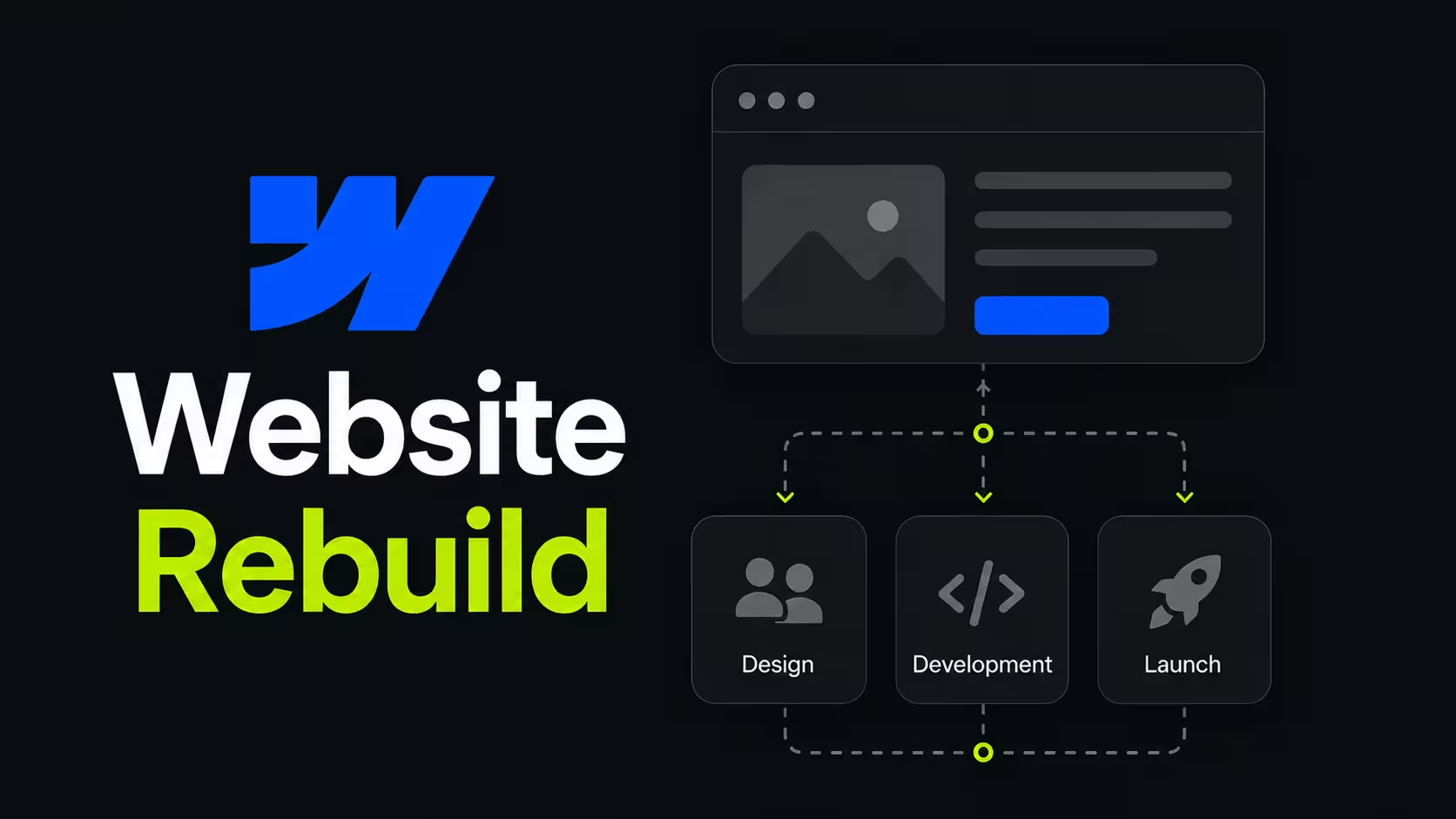
For a typical scale-up, the phases look like this:
Phase 1 - Discovery and strategy:
ICP audit, competitive positioning review, sitemap definition, and CTA architecture. The output is a clear brief - not a mood board, but a strategic document that answers what the site needs to say, to whom, and in what order.
Phase 2 - Design:
Visual design grounded in the brief. Every layout decision traces back to conversion logic and positioning, not personal preferences. A component library is designed from the start, not assembled after the fact.
Phase 3 - Build:
Component-first Webflow development with a CMS architecture designed for marketing team autonomy. The site is built so marketing can publish new pages, update content, and create campaign variants without engineering involvement. GTM stack integrations - HubSpot, Salesforce, GA4, Clay - are scoped and tested before launch.
Phase 4 - Launch and enablement:
Pre-launch QA, go-live, and a proper enablement process so the team knows how to use what was built. Not a Loom recording. A live walkthrough, documentation, and a support window while the team finds its footing.
This is the model behind what we at Designbase call the Full-Service Relaunch - the idea that a website rebuild without strategic foundation is just a more expensive version of the same problem.
How Much Does It Cost to Rebuild a Website
Website rebuild timeline and cost are the two questions teams usually ask early, and they are difficult to answer honestly without scope.
A full strategy-first rebuild for a B2B SaaS marketing site - including discovery, design, Webflow development, and GTM integrations - typically starts at €10,000 depending on the number of pages, CMS complexity, integration requirements, and graphic work. If the design already exists and the scope is pure Webflow development, that range is lower.
Most clients pair the rebuild with an ongoing growth retainer, starting at €2,500/month with a three-month minimum commitment - since a site built strategy-first needs continued iteration to keep compounding the gains from the rebuild, not a one-time handoff.
The more useful framing is total cost of inaction. A misaligned website that underperforms on conversion by even a small percentage compounds across every channel. Every paid campaign, every outbound sequence, every piece of SEO content is sending traffic to a site that is converting below its potential. Over 12 to 18 months, that gap is often worth more than the rebuild cost.
SEO Preservation During a Rebuild
One of the most common reasons companies delay a rebuild is the fear of losing organic rankings. Don’t get me wrong - that fear is legitimate. Website redesigns that are not executed with SEO in mind can and do cause traffic drops - sometimes significant ones. But the loss is not inevitable. It's a function of process.
An SEO-safe rebuild requires several things: a full URL audit before anything is changed, a complete redirect map that accounts for every page that moves or is retired, metadata transfer from the old site to the new CMS, and post-launch monitoring that catches indexing issues before they compound.
If the rebuild also involves moving to a new platform, for example moving from WordPress to Webflow, the same principles apply. A migration done correctly, with a proper redirect strategy and a pre-launch SEO benchmark, should hold rankings and often improve them. Webflow’s clean codebase, built-in performance, and direct access to SEO settings tend to produce stronger Core Web Vitals scores than plugin-heavy WordPress setups, which is an increasingly important ranking signal.
After the Rebuild: What Changes
A website rebuild only matters if it changes how the team operates after launch. That’s the real return on a full-service relaunch. The site stops being a bottleneck and starts acting like part of the GTM system. Marketing can launch landing pages without dev tickets, test campaign variants in hours, and add new content or comparison pages without waiting for a development sprint. For the first time, the website moves at the speed of the business instead of lagging behind it.
That’s why timing matters. If the problem is only visual, a lighter redesign may be enough. If the company is still figuring out product-market fit, a full rebuild may be too early. But once the ICP is clear, the GTM motion is repeatable, and the website is holding the business back in positioning, ownership, or conversion, the rebuild becomes part of the infrastructure the next stage of growth depends on.
FAQs
The clearest signal is when the site no longer reflects how the business actually sells. That can mean positioning drift - where the homepage message no longer matches what sales says on calls - or operational drag, where marketing cannot publish pages without engineering involvement. A website that requires dev tickets for copy changes, cannot support campaign landing pages at speed, or is converting below expectations despite consistent traffic is usually past the point where patching makes sense. At that stage, a rebuild is not a creative project. It’s a GTM infrastructure decision.
A redesign is primarily visual. It updates the look and feel while keeping the underlying structure, CMS, and content architecture largely intact. It is appropriate when the strategic foundation is still sound and the site mainly needs a visual refresh.
A rebuild is more fundamental. It starts with strategy - ICP alignment, messaging architecture, buyer journey mapping - and works down to design, CMS structure, and development. The output is a site that is structurally aligned with where the business is today, not just visually updated. For most B2B SaaS companies where the trigger is positioning or operational independence, a rebuild produces the right outcome. A redesign produces a more expensive version of the same problem.
A full scope rebuild - from strategy through launch - typically runs 8 to 12 weeks depending on the number of pages, CMS complexity, and integration requirements. Discovery and strategy takes around two weeks. Design takes two to three weeks. Webflow development takes three to four weeks. Launch and enablement takes one week. The phases that most commonly extend the timeline are discovery - if positioning decisions take longer to align internally - and development QA. Rushing either of those phases is the most reliable way to create post-launch problems.
Not if it’s executed correctly. The traffic drops that teams worry about are real, but they are almost always a function of process rather than platform. A rebuild that includes a full URL audit, a complete redirect map, metadata transfer to the new CMS, and a post-launch monitoring period should hold rankings. In many cases, the new site performs better on Core Web Vitals than the previous one, which is an increasingly important ranking signal. The key is treating SEO preservation as a named phase in the project, not something addressed after go-live.
A Website Rebuild, a full technical rebuild on a clean component system, starts at €10,000, typically €12,000 to €22,000 for a standard B2B SaaS marketing site. The range reflects differences in page count, CMS complexity, and technical debt. The more useful frame than upfront cost is the total cost of inaction. A site that underperforms on conversion across all inbound, paid, and outbound traffic compounds that gap over time. Most teams find the rebuild pays for itself within 12 to 18 months through improved conversion rates and reduced operational overhead.