
Webflow CMS is one of the main reasons teams choose Webflow in the first place. It gives marketers and designers a way to manage content without breaking the design system, and it gives growing teams more control over publishing without relying on constant developer input.
That matters because content is rarely static. Landing pages change, blog posts grow, case studies get added, and campaigns need new pages fast. If your CMS slows that down, it becomes a bottleneck instead of a growth asset.
What is Webflow CMS?
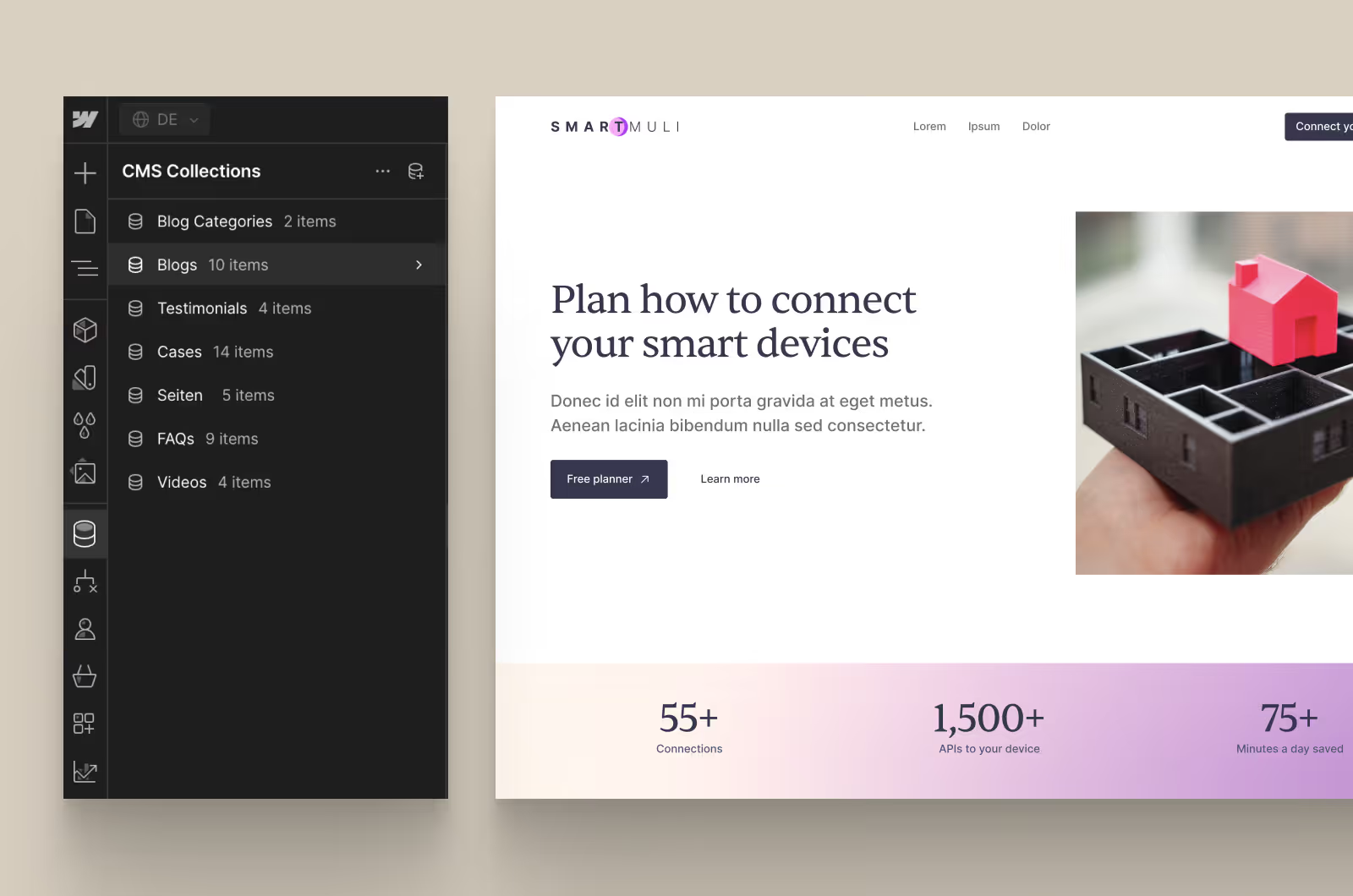
Webflow CMS is the content layer inside Webflow that lets you structure, manage, and publish dynamic content without giving up design control. It sits between a traditional CMS and a visual website builder: marketers can update content, while designers keep control over layout and presentation.
In practical terms, Webflow CMS is built around two content types: static pages and CMS collections. Static pages are best for one-off experiences like home, about, or service pages, while CMS collections are used for repeatable content like blog posts, case studies, team members, resources, or events.
Collections work like structured databases. You define the fields once: title, image, author, date, rich text, or reference fields and then create collection items that automatically populate collection templates and collection lists across the site. That is what makes Webflow CMS useful for scaling content without rebuilding every page by hand.
As of 2026, Webflow’s next-gen CMS has significantly expanded what teams can do with dynamic content. Webflow now supports up to 40 collection lists per page, up to 10 nested collection lists with as many as 100 items per nested list, and multi-level nesting up to three layers deep. Those changes make the CMS much more capable for content-rich pages, directories, resource hubs, and other structured layouts.
The real benefit is not just storage. It’s the ability to design once, scale content cleanly, and publish faster without relying on custom backend development for every change. For marketing teams, that means more control, less friction, and a CMS that actually supports growth instead of slowing it down.
Pages vs CMS Collections
Webflow separates content into two main types: static pages and CMS collections. Static pages are built individually, while CMS collections are built around repeatable content structures.
A static page is best for one-off pages like homepages, about pages, service pages, or contact pages. These pages are designed independently and do not need to share the same template.
A CMS collection is better for content that follows a pattern, like blog posts, case studies, team members, resources, or events. Each item in the collection uses the same structure, which makes it easier to scale content without rebuilding every page from scratch.
How Webflow CMS Collections Work
A Webflow CMS collection works like a structured content database. You define the fields first, then create individual collection items using those fields.
Each collection item can automatically generate its own page using a template. That template controls how the content is displayed, so if you update the design once, every item in the collection reflects that change.
This is one of the reasons Webflow CMS is useful for marketing teams. It creates consistency without removing flexibility, and it makes content updates much faster than editing pages one by one.
Webflow CMS Fields

Webflow CMS gives you a flexible set of field types that let you build structured, scalable content without forcing everything into the same layout. The field you choose shapes how content is stored, reused, and displayed, so this is one of the most important parts of building a clean CMS structure.
The most common Webflow CMS fields are:
- Plain text
Best for short content like titles, names, labels, short descriptions, or slugs. Use this when you need a clean single-line value with no formatting.
- Rich text
Best for formatted content such as blog posts, long-form pages, detailed descriptions, and editorial content. It supports headings, paragraphs, lists, links, bold and italic text, images, and videos, which makes it the most flexible content field in the CMS.
- Image
Best for featured images, thumbnails, team photos, product visuals, and any content where the visual asset is part of the page structure. It supports standard web image formats and works well with dynamic layouts.
- Multi-image
Best when one CMS item needs a gallery, image sequence, or multiple supporting visuals. This is useful for portfolios, case studies, product galleries, and any page that needs more than one image per item.
- Video link
Best for storing video URLs from platforms like YouTube, Vimeo or Vidzflow. It lets you embed video directly into collection templates without hardcoding each instance.
- Link field
Best for external URLs, landing pages, or internal destination links. Use it when the CMS item needs to point somewhere specific, such as a resource, article, campaign page, or client website.
Best for valid email addresses in team profiles, contact directories, speaker pages, or registration-based content. It keeps structured contact data clean and consistent.
- Phone
Best for phone numbers in contact pages, directories, support listings, or profile records. It is useful whenever the CMS item needs a direct contact method.
- Number
Best for numeric data such as prices, quantities, rankings, metrics, or any value that needs to be calculated or displayed consistently. This field is especially useful for data-driven content.
- Date/Time
Best for publish dates, event dates, launch dates, deadlines, and editorial planning. It supports both date-only and date-time use cases, so it works well for content that depends on timing.
- Switch
Best for simple on/off states such as featured, published, in stock, or highlighted. It is one of the easiest ways to control visibility or status inside a collection.
- Color
Best for storing HEX color values that can be reused dynamically across a design. This is useful for category colors, branded labels, campaign accents, or any CMS-driven visual system.
- Option
Best for predefined dropdown values where consistency matters. Use it for statuses, content types, categories, or any field that should only allow one selected value.
- File
Best for downloadable assets such as PDFs, documents, spreadsheets, media files, or resource attachments. This is useful for gated content, libraries, portfolios, or document-heavy pages.
- Reference
Best for linking one CMS item to a single item in another collection. This creates a one-to-one relationship, such as a blog post linked to one author or a product linked to one category.
- Multi-reference
Best for linking one CMS item to several items in another collection. This is ideal for tags, topic clusters, related content, or any content model that needs multiple connected relationships.
These field types matter because they let you build the CMS around how content actually works on the site. A blog, case study, resource hub, and team directory all need different structures, and Webflow gives you enough flexibility to model each one properly.
For example:
- A blog collection might use plain text, rich text, image, date, author reference, and tags.
- A case study might use title, client name, logo, quote, results, industry, and CTA fields.
- A resource library might use title, description, file, topic, format, and featured toggle.
That is what makes Webflow CMS useful as a source of truth. The fields do not just store content - they define how the content scales, connects, and performs across the site.
Collection Page Templates
Every CMS collection in Webflow can have its own page template. That template is where the collection item content gets output on the live site.
This is what makes Webflow CMS powerful for scalable content systems. You can design one template and use it for many pages, which saves time and keeps the experience consistent.
The trade-off is that templates are less flexible than fully custom pages. But that is usually a good thing for structured content, because it creates order and makes large sites easier to manage.
Linking Fields to the Design
Once a collection exists, you connect its fields to the page template. That is how the CMS data gets displayed in the design.
A common example is a blog template. You design the post layout once, then link the H1 to the title field, the author block to the author field, the featured image to the image field, and the body area to the rich text field.
Once those links are in place, each new item automatically renders with the correct content. That’s what makes the system efficient: content is stored in the CMS, and the template handles the presentation.
Live Editor Experience
Webflow also gives editors a more visual way to manage content. Instead of working only through a traditional admin backend, users can edit content in a more front-end-oriented experience.
That makes it easier to see how changes will look before publishing them. For teams that need to move fast, this reduces friction and lowers the risk of publishing content that looks off once live.
It also makes collaboration easier. Marketing teams, editors, and clients can work in a system that feels more visual and less technical than traditional CMS setups.
Key Benefits of Webflow CMS
Webflow CMS is popular because it combines structure, speed, and design control in one system. That makes it easier for teams to manage content without losing brand consistency or waiting on constant development support.
The biggest benefits are:
- Faster content updates.
- Stronger design consistency.
- Easier collaboration.
- Better control over repeatable content.
- Less dependency on developers for everyday publishing.
For teams running campaigns, publishing content, or maintaining a growing site, that combination is a real operational advantage.
Webflow CMS and SEO
Webflow CMS also supports a strong SEO workflow. You can manage metadata, structured content, and page-level optimization without relying on a stack of extra plugins.
That is useful because many SEO tasks can live directly inside CMS fields. Titles, meta descriptions, slugs, schema-related content, and other structured elements can all be handled in a way that scales across collection pages.
Performance is another major benefit. Webflow includes CDN delivery, image optimization, and modern asset handling, which helps content load quickly. For content-heavy sites, that can support better user experience and stronger technical SEO foundations.
Webflow CMS vs WordPress
Webflow CMS and WordPress solve some of the same problems, but the operating model is very different.
WordPress offers a much larger plugin ecosystem and more flexibility for certain complex use cases. That makes it a strong choice for teams that need a highly customized stack or a very broad publishing setup.
Webflow, on the other hand, is built around a visual design workflow with hosting, updates, and maintenance handled inside the platform. That makes it easier to keep the site lean and easier to run without ongoing plugin management.
For marketing teams, the choice often comes down to ownership. If the goal is faster publishing, tighter control, and less technical overhead, Webflow CMS is usually the cleaner option.
Who Webflow CMS Is For
Webflow CMS is a strong fit for teams that treat the website as a commercial asset, not just a digital brochure. It works especially well for B2B marketing teams, SaaS companies, agencies, and founders managing a site that needs to grow without becoming harder to run.
We recommend it when content needs to scale cleanly. If your site relies on repeating structures, frequent updates, landing pages, or campaign content that needs to move fast, Webflow CMS gives you the structure and flexibility to do that without creating unnecessary friction.
Webflow CMS without a doubt supports the way modern marketing teams actually work. It gives you control without forcing every update through development, and it keeps the site structured without boxing you into rigid templates.
That makes it especially useful for growth-focused websites. The CMS supports content, but it also supports speed, consistency, and ownership - which is why it becomes part of the operating system, not just a content tool.
Is It Worth Considering?
Webflow CMS is worth considering if you want a website that is easier to manage, easier to scale, and easier to keep aligned with your brand. It’s especially strong when content is part of the growth engine and not just an afterthought.
The real value is not just that it stores content. It’s that it lets teams build a repeatable content system without giving up design quality or publishing speed.
For the right team, that is a meaningful advantage worth exploring.
FAQs
Webflow CMS is the content layer built into Webflow that lets marketing teams manage and publish dynamic content without needing a developer for every change. It connects content and design in one environment - what you build is what you see live.
The system is built around two content types: static pages for one-off experiences like a homepage or about page, and CMS Collections for repeatable content like blog posts, case studies, or resource libraries. Collections work like structured databases: define the fields once, then every item automatically populates your templates across the site. Update the template once, and every piece of content reflects the change.
For growing teams, the practical result is faster publishing, fewer bottlenecks, and more control over the site without relying on a development queue.
Yes - and especially since April 2026, when Webflow completed the migration of all sites to its next-gen CMS architecture.
The updated limits: up to 40 Collection lists per page, 10 nested Collection lists with up to 100 items each, and multi-level nesting up to three layers deep. For enterprise plans, collections can scale to over one million items. These aren't edge-case numbers - they make complex pages like resource hubs, directories, and data-rich templates genuinely manageable without custom backend work.
For most marketing sites, the standard limits are more than enough. For teams building content programmes at scale, the platform has matured to match that ambition.
Yes, and it handles the core SEO workflow natively, without the need of further plugins. Meta titles, descriptions, canonical tags, alt text, and URL slugs are all manageable directly inside CMS fields, so they scale automatically across collection pages. Sitemaps regenerate on every publish.
As of early 2026, Webflow AI (available on paid plans) adds AI-generated metadata, schema markup, and an audit panel that flags issues site-wide. Webflow also now tracks AI referral traffic natively (traffic arriving from tools like ChatGPT or Perplexity) which matters as AEO becomes part of how content teams measure visibility.
The one honest possible downside: teams running very large SEO programmes with complex structured data needs may find WordPress plugins offer more depth in that specific area. However, for most marketing-led sites, Webflow's native tools are more than sufficient.
They solve similar problems differently. WordPress has a larger plugin ecosystem and handles very high-volume content operations well - but that flexibility comes with maintenance overhead: plugins, hosting, security patching, and regular developer involvement just to keep things running.
Webflow puts CMS, hosting, SEO tools, and design in one environment. Marketing teams can publish pages, update content, and manage SEO independently. Developers are only needed for new components or structural changes, not for day-to-day publishing.
The clearest signal how to choose: if your team spends meaningful time managing WordPress rather than publishing on it, Webflow is worth a serious look. If you need very large-scale content operations or a deep plugin ecosystem, WordPress still has an edge there.
Based on where the platform sits in 2026, yes - with one trade-off worth understanding in context.
Webflow has moved fast: AI-assisted content management via a Claude connector, Webflow AEO for optimizing content to appear in AI-generated answers, native AI referral tracking, and a next-gen CMS architecture built for structured, interconnected content. The platform is clearly building toward a place where publishing speed, design control, and AI discoverability live in one system.
The trade-off that gets raised most often is lock-in. Webflow is a hosted platform, but CMS content is exportable via CSV and third-party migration tools exist. It's also worth mentioning this isn't a Webflow-specific problem, for example WordPress sites built on page builders like Elementor export content full of shortcodes that make the export largely unusable on another platform. Every serious CMS has a switching cost. For most B2B SaaS teams, the operational benefits outweigh it - but it's worth understanding before you commit.
A static page is a one-off page you build manually in the Webflow Designer, like your homepage, about page, or a campaign landing page. The content is fixed directly in the design. If you want to change something, you go into the Designer and change it.
A CMS template is a single page design that dynamically renders content from your CMS collection. You build the template once, and Webflow uses it to generate a unique page for every item in that collection.
When you add a new blog post to your CMS, it automatically gets its own live page with a unique URL. The layout always stays consistent, only the content changes per item.
What this means in practice: static pages are used for unique pages with custom design logic. CMS templates are used for anything that repeats at scale, like blog posts, integration pages, case studies, comparison pages, team members.
No. In Webflow, each CMS collection can only have one Collection Template page. Every item in that collection renders through the same template.
The workaround most teams use is conditional visibility. You can show or hide entire sections within the template based on a field value in the CMS item - a toggle, a category tag, or a reference field. So while the template is one page, it can behave differently depending on the content of each item. For example, a blog post tagged with "case study" can show a different layout block than one tagged "how-to guide" - all from the same template.
If you really need structurally different page designs for different content types, the cleaner solution is to split them into separate CMS collections, each with its own template.